

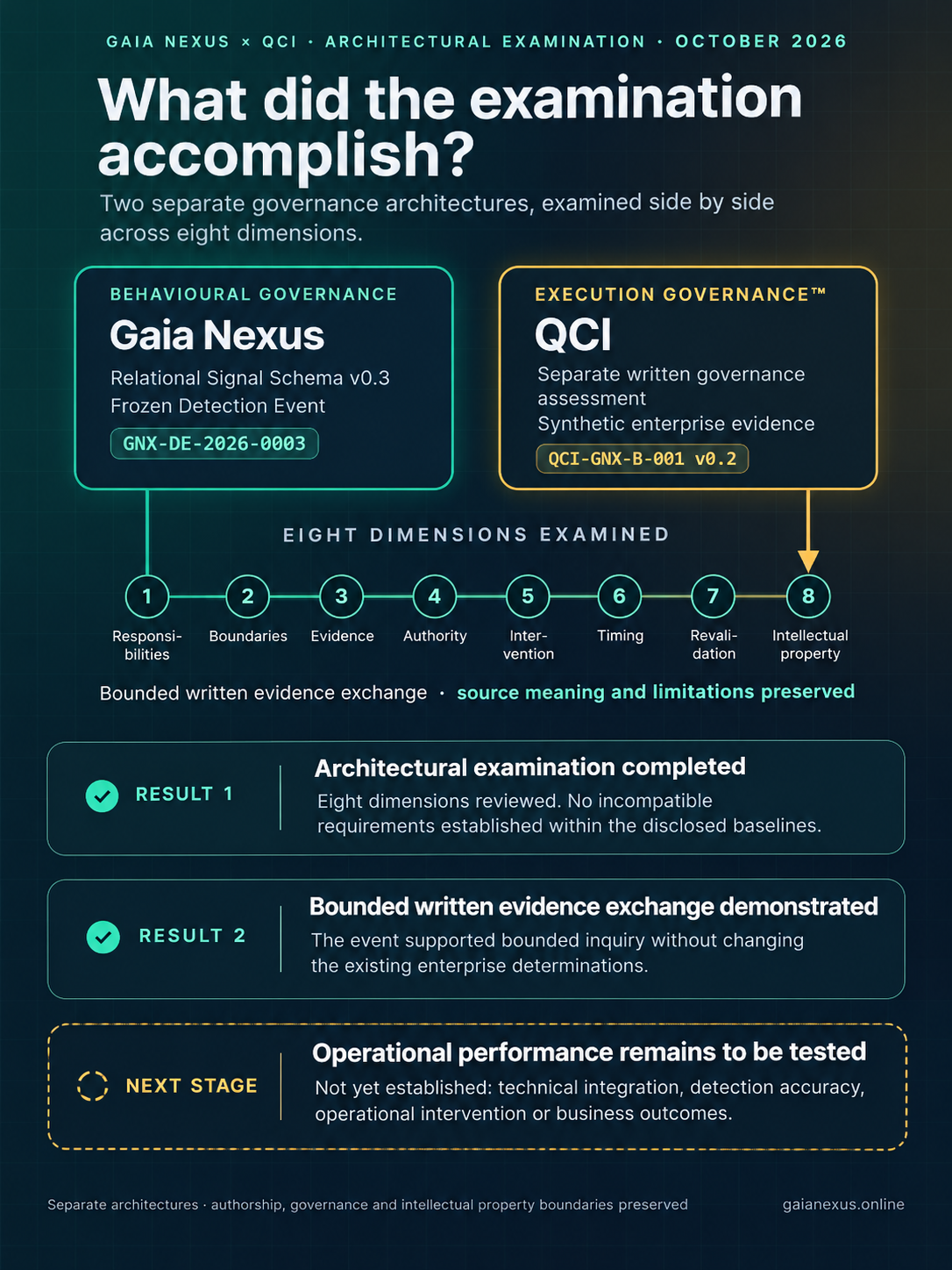
Gaia Nexus has completed an eight dimension architectural examination with Quantum Competitive Intelligence™ (QCI), founded by Jay VonSpreck, examining how our proprietary behavioural governance architecture relates to QCI’s Execution Governance™ architecture.
Conducted between 1 and 16 October 2026, with the written closeout accepted on 17 October 2026 (AEST, UTC+10), the examination produced two significant findings.
First, no incompatible architectural requirements were identified across any of the eight dimensions examined.
Second, QCI independently examined a Gaia Nexus Detection Event within its own enterprise governance assessment.
This represents an important development milestone for Gaia Nexus. It provides documented findings about how our evidence can be considered by an independently developed governance system, while preserving each architecture’s responsibilities and intellectual property.
It also identifies practical requirements for the next stage of development and interoperability testing.
Gaia Nexus produces structured Detection Events that can report potential changes in how people work with AI, including their reliance on AI recommendations, independent verification and ability to exercise meaningful oversight.
An important question is whether another enterprise governance system can independently examine that evidence and determine what it justifies.
QCI provided an opportunity to examine this question against its disclosed Execution Governance™ architecture.
The examination covered eight areas of enterprise governance:
These were eight areas of architectural examination, not eight live operational tests.
The examination considered whether the disclosed requirements of Gaia Nexus and QCI could be assessed alongside one another, and what would be required for Gaia Nexus evidence to contribute to QCI’s independent governance assessment.
Gaia Nexus supplied its Relational Signal Schema v0.3 and one frozen Detection Event, identified as GNX-DE-2026-0003.
QCI supplied its disclosed Execution Governance™ baseline and a separate synthetic enterprise evidence packet, QCI-GNX-B-001 v0.2.
The materials were kept unchanged during the comparison.
Each architecture was examined through written exchanges, and the findings were reviewed and agreed by both parties.
The business situation was simulated. No live enterprise integration or operational intervention was tested.
First, Gaia Nexus evidence could be considered within QCI’s independent written assessment.
QCI received the frozen Detection Event and examined it alongside its own enterprise evidence.
This demonstrated a bounded written evidence exchange, not a technical integration.
The event remained attributable to Gaia Nexus, while QCI retained responsibility for its own assessment and conclusions.
Second, a warning was not mistaken for proof.
QCI did not automatically accept Gaia Nexus’s severity classification as a measure of enterprise importance.
Nor did it conclude that employees had become dependent on AI or lost their judgement.
The limitations of the evidence remained visible.
The available evidence was not sufficient to confirm that employees had actually reduced their independent checking or lost the ability to exercise judgement.
Third, the additional evidence did not change QCI’s existing enterprise determinations.
For the particular synthetic business situation, QCI’s conclusions remained unchanged after considering the Gaia Nexus event.
However, the event provided a separate reason for further, limited investigation.
That distinction is important in business governance. Not every warning should trigger an intervention, but neither should every unresolved concern be ignored.
Fourth, the examination identified specific requirements for further development.
These included requirements for evidence traceability, supporting information, timeliness, corrections and responsibilities between systems.
Finding 1: No incompatible architectural requirements identified
Across all eight dimensions, no incompatible architectural requirements were identified between Gaia Nexus and QCI within their disclosed specifications.
This means the examination did not identify conflicting requirements that prevented the two disclosed approaches from being considered alongside one another.
For Gaia Nexus, this provides a documented basis for further interoperability work.
Compatibility, complementarity and integrability were not established by this examination.
Finding 2: Independent examination of Gaia Nexus evidence
Gaia Nexus supplied a structured Detection Event containing a source reported warning about a possible reduction in how people were independently checking AI supported information.
QCI independently examined that warning alongside its separate synthetic enterprise evidence.
Limitation: Live operational performance remains to be tested
The examination did not involve a live enterprise deployment or a working technical integration between Gaia Nexus and QCI.
It did not independently validate Detection Event accuracy against real-world changes in human oversight or establish improvements in intervention effectiveness, operational performance or financial outcomes.
This comparison did not test or establish whether either architecture improves real world governance outcomes.
These are matters for future testing, rather than failures of the completed architectural examination.
The examination produced the following bounded results.
1. Architectural examination completed
Eight dimensions reviewed. No incompatible requirements established within the disclosed baselines.
2. Bounded written evidence exchange demonstrated
QCI examined the Gaia Nexus Detection Event within its separate written governance assessment, preserving the source meaning and limitations. The event supported bounded inquiry without changing the existing enterprise determinations.
3. Operational performance remains to be tested
The examination did not establish technical integration, detection accuracy, effective operational intervention or improved business outcomes.
Beyond the two principal findings, the examination identified practical requirements for future interoperability.
These included how to:
These findings provided Gaia Nexus with specific development requirements for subsequent schema work and further testing.
They do not mean every technical or operational requirement has already been resolved.
As businesses introduce more AI into their operations, they need to understand not only how the technology performs, but also how it affects the people working with it.
For example, an organisation may have records showing that AI supported tasks were completed correctly and that the required approvals were obtained.
But those records may not reveal whether employees are becoming less likely to question AI recommendations, independently verify information or intervene when something appears wrong.
This creates a potential opportunity for organisations to use Gaia Nexus evidence alongside their existing enterprise governance processes.
The opportunity becomes particularly relevant as enterprises introduce AI agents capable of performing tasks, coordinating workflows, making recommendations and taking actions within defined permissions.
Consider a hospital using AI agents to support clinical or administrative work.
Its existing systems may record what an agent did, whether it completed a task and whether required approvals were obtained.
However, those records may not fully reveal whether the people supervising the agents are continuing to independently check recommendations, question unexpected results and exercise meaningful oversight.
Gaia Nexus could potentially contribute structured evidence about changes in those human oversight conditions for the hospital’s existing governance systems to examine.
Similar opportunities could arise in financial services, insurance, professional services and other environments where AI increasingly influences consequential decisions.
The wider opportunity is to help enterprises recognise potential changes in how people work with AI that their existing technical and operational assessments may not capture.
The QCI examination provides an initial architectural basis for exploring this application. Technical integration and performance in live AI agent environments remain to be tested.
The completed examination has provided documented findings and practical requirements that will inform the next stage of Gaia Nexus development.
Gaia Nexus has since completed and frozen Relational Signal Schema v0.4 as its current testing baseline, building on the completed v0.3 examination and findings from other independent testing.
The updated Schema and Detection Event examples strengthen how supporting evidence, timing, uncertainty, revalidation and review conditions are represented and communicated. These materials are now being used to support further testing with independently developed systems.
The objective is to establish how Gaia Nexus evidence can contribute to enterprise governance in practical operating environments, while organisations retain responsibility for their own decisions and actions.
Examination scope: This was a bounded written architectural examination using source reported and synthetic evidence. This comparison did not test or establish whether either architecture improves real world governance outcomes.
The architectures remain separate, with their respective authorship, governance and intellectual property boundaries preserved.