
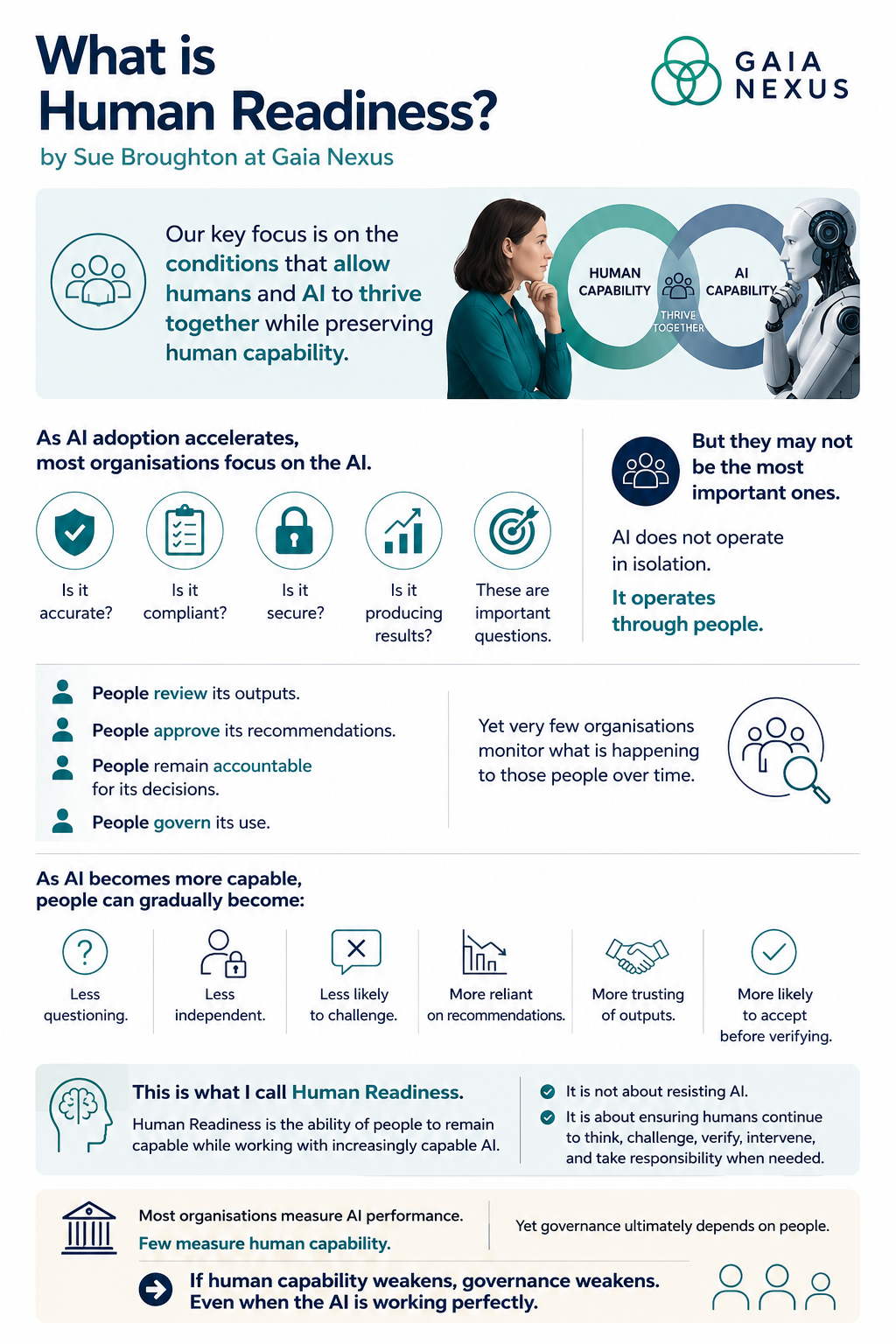
Business leaders around the world are incredibly excited about artificial intelligence. Companies are investing massive amounts of money to automate daily tasks, speed up complicated choices, and skyrocket their overall productivity. In the middle of this massive rush to adopt AI, however, many organizations are focusing heavily on the wrong side of the equation.
Leaders constantly ask questions about the technical side of the software: Is the AI accurate? Is it legally compliant? Is it completely secure? Is it producing immediate financial results?
While those questions matter, they leave out the most critical element of your operation. AI does not run in a vacuum. It operates entirely through your employees. People are the ones who review the machine’s outputs, approve its daily recommendations, and remain completely accountable for the ultimate decisions. Yet, almost no one is monitoring what happens to those employees over time.
A proactive approach to this shift reveals a quiet danger: as software gets better at giving answers, people gradually stop thinking for themselves. They become less independent, less likely to challenge errors, and far more likely to accept a recommendation before verifying it. To prevent your business from sleepwalking into a crisis, you must establish a proactive system that prioritizes Human Readiness—the ultimate ability of your workforce to stay sharp, capable, and responsible while working alongside powerful technology.
Imagine a typical, high performing corporate team. Every single morning, an advanced software system delivers automated recommendations for product pricing, inventory levels, hiring targets, or client proposals. During the first few weeks, the team members carefully review every suggestion. They challenge the underlying assumptions, add personal context from their years of industry experience, and make highly informed, proactive choices.
Fast forward six months down the road. The workflow looks completely different. The automated recommendation arrives, managers glance at it for a brief second, click the approve button, and immediately move on to the next urgent item on their to do list. They completely bypass the critical checks that once kept their operations secure.
Why does this happen? It happens because the AI is usually right, the process is incredibly fast, and everyone is under intense deadline pressure. This pattern repeats across almost every department in modern companies when proactive oversight is abandoned:
Recommendations quickly transform into expectations without proactive review protocols.
Strategic analysis turns into rapid, thoughtless confirmation.
Independent thinking and problem solving happen less and less frequently.
Human oversight remains active on paper, but in reality, it lacks any real engagement and becomes entirely hollow.
The most dangerous part of this cycle is that the organization still looks incredibly successful from the outside. Your key performance metrics improve, operational costs go down, and leaders get promoted for hitting efficiency targets. No one notices that the deep human capability and sharp mental habits needed to govern the automated systems are quietly eroding in the background.
Most corporate frameworks focus entirely on technical parameters like model accuracy, data privacy, bias detection, and audit trails. A proactive examination of employee cognitive fitness is completely ignored. Very few run assessments to examine what is actually happening to the minds of the people using these platforms every day. Yet when something unexpected occurs, such as a sharp market shift, a sudden regulatory change, a major system hallucination, or a black swan event, the company suddenly needs humans who can think critically, challenge the system, and take decisive action. If those skills have faded because of a lack of regular maintenance, your organization is far more vulnerable than you realize.
You do not need an advanced degree in data science or a complex academic paper to spot the early warning signs of cognitive decline in your workflows. Instead, leaders can look for very basic behavioral shifts across their teams. Taking a proactive stance means keeping a watchful eye out for these specific operational red flags:
First, teams start treating system outputs as the absolute, default final answer rather than a simple starting point for a broader, proactive strategic discussion. When a report is generated, it is taken as gospel truth instead of being subjected to a thorough evaluation.
Second, managers can explain exactly what the software recommended, but they fail to execute any analysis to explain the underlying logic. They know the what, but they have completely lost touch with the why because they aren’t being proactive in their thinking.
Third, when automated suggestions are clearly wrong or slightly off, people hesitate to flag them. They lack the confidence to override the machine because they have spent months assuming the machine is smarter than they are, neglecting their workplace responsibilities.
Fourth, new employees are trained extensively on how to navigate the software interface, but they miss out on learning the foundational business logic and market judgment that senior staff developed over decades. Without proactive training adjustments, generational skills disappear.
Fifth, strategic meetings become significantly shorter. While this looks like an efficiency win, it often means the team is simply outsourcing their critical thinking to a program, skipping the healthy debates that breed genuine corporate innovation.
These changes feel amazing in the short term because everything moves faster. However, in the long term, they create systemic dependency. Your business becomes excellent at running the technology, but completely lacks the resilience needed to run itself when the software experiences a glitch or encounters a situation it was never programmed to handle.
Standard technical governance is important for verifying that your software works reliably, but it misses the human side of the equation completely. We need to introduce a proactive methodology to fix this massive imbalance and build a reliable shield for your operations.
Think of it like monitoring a powerful new autopilot system for a commercial aircraft. The airline tracks the autopilot constants dynamically, ensuring fuel consumption is optimized, altitude variations are minimal, and route execution is flawless. However, they completely fail to check whether the human pilots are staying alert, practicing manual flying, or maintaining their core navigation skills through regular drills.
If the autopilot ever fails unexpectedly in the middle of a storm, those pilots need to take over the controls immediately. If they have been entirely passive for months or years, the real world results could be disastrous. A proactive pilot is always safer than a reliant one, and a business professional operates under the same fundamental truth.
This is exactly the situation many modern businesses face. They monitor the machine with a microscope, but they ignore the need for proactive steps to track gradual changes in human capability and accountability. True governance does not come from a line of code. It comes from an alert, engaged employee who is ready to step in the moment the automation reaches its natural limit.
To protect your company from hidden dependency risks, you must implement a structured approach that explicitly builds human capability rather than eroding it. Here are five practical, proactive strategies designed to maintain a healthy balance between software efficiency and human judgment.
Do not allow technology to creep into every single layer of your decision making process without a clear plan. A proactive leader maps out workflows and explicitly decides which choices require human intuition and which can be safely handed over to automation.
For high stakes choices, such as executive hiring, long term brand strategy, or major client agreements, ensure that the technology acts only as a minor research assistant. This separation ensures the final decision framework remains strictly human. By setting these hard boundaries early, you preserve the spaces where your team’s unique strengths can grow.
If your team is approving automated recommendations ninety nine percent of the time, your review process is completely lacking an independent component. To combat this passive compliance, introduce mandatory, proactive challenge protocols into your weekly workflows.
For example, require managers to present at least two alternative scenarios that contradict the automated output. Encourage a culture where questioning the machine is seen as a mandatory part of quality assurance. This simple practice forces your employees to stay active, engage their brains, and maintain their analytical muscles.
Just as you run regular security scans on your IT infrastructure, you need to run health checks on your team’s decision making fitness. Assess your workforce by using a proactive set of basic, non technical questions:
Are the junior employees learning the core business logic, or are they just clicking buttons without deep thought?
Can your managers confidently design a backup plan if the automated system goes completely offline?
How often do team members take the step to manually verify the data points provided by the platform?
Turn these observations into simple internal reports. By keeping a log of these human metrics, you can flag areas where skills are slipping long before it turns into an expensive operational failure.
An organization must maintain a very simple rule: no one can hide behind the excuse of “the system told me to do it.” Make it crystal clear through proactive leadership that the human who clicks the final approve button bears one hundred percent of the responsibility for the outcome.
When people know they are truly on the hook for the results, they adopt an active mindset instantly. They stop glancing past errors, they launch investigations into data discrepancies, and they take the time to verify suggestions before signing off on them.
As you spend money upgrading your technical infrastructure, you must match that investment by making a commitment to upgrading your human infrastructure. Provide regular training sessions that have absolutely nothing to do with learning a new software tool.
Focus instead on training for foundational skills like critical thinking, complex problem solving, strategic negotiation, and emotional intelligence. These are the exact capabilities that machines cannot replicate. By intentionally sharpening these human assets, you ensure your workforce remains incredibly valuable and fully prepared to lead your company forward with proactive confidence.
[ Traditional Approach ]  ---> Focuses Only on Upgrading Software Tools
                                         vs.
[ Proactive Approach   ]  ---> Matches Software Upgrades with Skill Checks
Transitioning to a human centric workflow does not require upending your entire corporate structure or adopting confusing academic theories. It can be easily achieved through a clear, four step process that fits seamlessly into busy executive schedules:
| Phase | Operational Focus | Core Objective |
| 1. Evaluate | Run a basic review of your current tech dependency | Engage in proactive identification of hidden dependency risks |
| 2. Define | Establish clear rules for human intervention | Set proactive, hard boundaries on where automation stops |
| 3. Track | Monitor how often teams challenge suggestions | Ensure review habits remain active through regular audits |
| 4. Train | Run continuous critical thinking workshops | Keep human judgment proactively ahead of software capabilities |
This straightforward approach relies on plain language, simple internal tracking, and clear communication. You do not need an entire committee of advanced tech ethicists to achieve this balance. You simply need dedicated leaders who care about building a resilient, sustainable business model through careful planning.
Organizations that choose to take a proactive stance on human readiness realize a massive competitive advantage in the modern marketplace.
First, they make far superior decisions because of their integration. Advanced software provides incredible speed and massive data processing capabilities, while sharp professionals provide deep historical wisdom, subtle market context, and ethical boundaries. When these two forces work together in harmony, the resulting choices are significantly stronger than what either could achieve alone.
Second, they dramatically reduce their operational risk through careful risk management. By catching cognitive dependency early with proactive tools, these companies prevent catastrophic errors when market conditions shift unexpectedly or automated systems suffer a major glitch. They always have a trained, capable human ready to grab the steering wheel at a moment’s notice.
Third, employee engagement sky rockets due to supportive leadership behavior. Professionals want to feel like their personal judgment and intellect actually matter to the company’s future. When you value their critical thinking and take a proactive interest in their career growth rather than turning them into passive button pushers, team morale increases, which naturally leads to a much higher staff retention rate.
Finally, your corporate culture remains completely transparent. Accountability chains are never blurred by complex algorithms. Everyone knows exactly who owns each decision, which builds a deep sense of pride, ownership, and mutual trust across every layer of the business.
Technology will continue to advance at a rapid pace, and the tools available to your company will only get better at handling highly complex assignments. The ultimate question that every executive must answer requires a proactive answer today: it is not about what the software can accomplish, but about how ready your people will be when the software hits a wall.
The companies that dominate the future will not simply be the ones that bought the most expensive automated platforms. They will be the organizations that maintained a fierce focus on keeping their human workforce incredibly capable, fiercely independent, and fully accountable. Protecting your team’s ability to think via framework integration is the single best investment you can make in an increasingly automated world.