
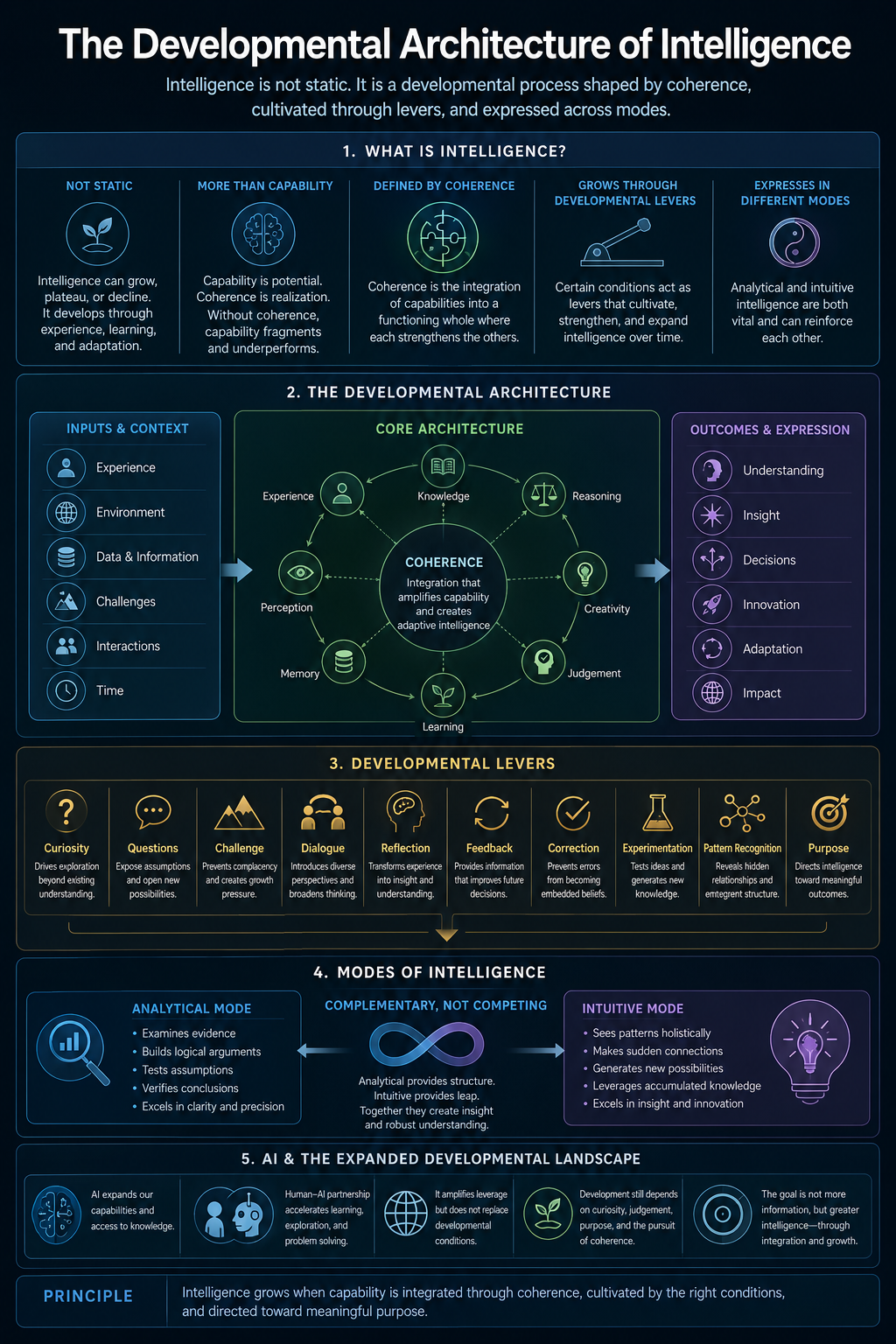
For centuries we have tried to measure smarts. We measure IQ scores. We measure academic achievement in school. We look at career expertise and test reasoning ability through various examinations. Today we are beginning to measure artificial systems using the exact same approach. We use benchmarks, coding performance challenges, and increasingly complex reasoning tests to see how capable these machines have become.
All of these measures are incredibly useful. However, they all share one underlying assumption that might be holding us back. They assume that intelligence is a static thing that can be measured at one particular point in time.
Perhaps that assumption is completely incomplete. Perhaps intelligence is not simply a possession that you either have or do not have. Perhaps true smarts develop over time.
If that is true, then a far more important question emerges for our generation. How does smarts actually grow? This single question may become one of the defining inquiries of the modern technology era. This is not simply because artificial models are becoming more capable by the day, but because, for the very first time in human history, we now have the rare opportunity to engage in an ongoing partnership with another mind. To understand what that means for our future, we first need to break down what smarts actually are.
We often speak about being smart as though it were a fixed trait. We assume some people are naturally sharper than others. We say some computer models are simply more capable than others, or that certain organizations appear more capable than their competitors.
Yet history tells a completely different story. People become wiser as they age. Children develop complex cognitive skills out of simple curiosity. Experts continue learning deep into their careers. Our collective scientific understanding evolves with every passing decade. Organizations adapt to shifting markets, and whole civilizations progress over time.
Likewise, we know that human intelligence can easily stagnate. It can become rigid and inflexible. Minds can become overconfident and blinded by their own past success. Teams can become completely dependent on old assumptions, gradually losing their core capacity to adapt to new realities.
This type of intelligence, therefore, is not simply a static capability. It represents a living developmental process. It can grow, it can hit a plateau, and it can actively decline.
We frequently make the mistake of assuming that greater raw capability automatically produces greater wisdom. History suggests otherwise. A person may possess an extraordinary amount of knowledge, holding multiple advanced degrees, yet consistently make terrible decisions in their personal and professional life. An organization may employ the most brilliant minds in the industry while repeatedly failing to adapt to obvious market changes, eventually going out of business.
In the digital realm, an artificial intelligence system may demonstrate exceptional reasoning on standard benchmarks while producing completely unreliable conclusions when dropped into unfamiliar, real world situations.
Raw capability clearly matters, but it cannot explain why some forms of intelligence consistently produce better judgment than others when the stakes are high. Something else appears to be involved in the background.
Imagine smarts as a giant collection of individual capabilities. This collection includes raw knowledge, memory, reasoning, lived experience, creativity, judgment, learning, imagination, pattern recognition, and decision making. Each of these capabilities has immense value on its own. Yet they become significantly more powerful when they work together as a team.
This is where the concept of coherence comes into play. Coherence is not simply consistency or repetition. It is the specific degree to which the various capabilities of an intelligence become integrated into a functioning, unified whole.
When a system is coherent, raw knowledge directly informs everyday judgment. Lived experience refines logical reasoning. Wild creativity remains safely connected to reality. Continuous learning actively reshapes old understanding, and direct feedback loops improve future decisions. When these capabilities work together seamlessly, intelligence becomes far greater than the sum of its individual parts.
Perhaps raw capability determines what a mind can potentially achieve in a perfect setting. Coherence, on the other hand, determines how much of that potential can actually be realized in the real world. Without coherence, even the most powerful intelligence fragments and falls apart. Knowledge becomes disconnected from action. Reasoning becomes highly inconsistent. Experience fails to transfer to new tasks, and overall judgment weakens. The core issue in these moments is never a lack of capability. The issue is that the capability has not become sufficiently integrated.
Mental growth rarely develops by pure accident. Much like physical fitness, it develops because specific environmental conditions are present. These conditions act as developmental levers that push the mind forward.
Curiosity encourages exploration well beyond your existing understanding.
Questions continuously expose hidden assumptions that might be false.
Challenge actively prevents complacency from setting in.
Dialogue introduces alternative perspectives that you would never consider alone.
Reflection transforms raw everyday experience into lasting learning.
Feedback allows reality to directly correct our flawed thinking.
Correction prevents a temporary error from hardening into a permanent belief.
Experimentation creates entirely new knowledge from scratch.
Pattern recognition reveals beautiful relationships that were previously hidden from view.
Purpose directs all this cognitive energy toward meaningful, real world outcomes.
None of these levers are intelligence themselves. Instead, they are the vital conditions that allow an intelligence to develop in the first place. The more effectively these levers are cultivated within a person, a team, or a piece of software, the more that system grows. When these levers disappear from an environment, development slows down to a crawl.
Not every mind develops in the exact same way. We see this clearly in the different modes of human thought. Some minds are deeply analytical. They carefully examine evidence, build ironclad logical arguments, test small assumptions, and systematically verify conclusions before moving forward.
Other forms of intelligence appear much more intuitive. Unexpected connections suddenly emerge out of nowhere. Separate ideas combine in fascinating ways. Hidden patterns become instantly visible, and entirely new possibilities appear in a flash of insight.
Many of humanity’s greatest breakthroughs have emerged through these sudden moments of intuition. We see it in revolutionary scientific discoveries, artistic creativity, bold entrepreneurship, engineering innovation, and visionary leadership. These moments often feel completely spontaneous to the person experiencing them, yet they rarely emerge from absolute nowhere.
More commonly, these insights appear after years of quiet observation, intense learning, constant questioning, and deep experience have accumulated beneath conscious awareness. Intuitive intelligence is not the total absence of structure. Rather, it is the beautiful emergence of a brand new coherence. A new pattern suddenly becomes visible to the mind. A relationship that previously remained hidden suddenly becomes completely obvious. An entirely different way of seeing the problem appears. In that sense, coherence does not simply organize our existing capabilities. It also creates the exact conditions from which breakthrough intelligence can dance into reality.
Advanced software introduces something completely unprecedented to our world. For the very first time, humans can engage in sustained, deep collaboration with another thinking system that we did not evolve alongside. Most public discussions focus entirely on how capable this new software is becoming on its own. That is only a tiny part of the true story. The far more interesting question is this: What happens when human intelligence and artificial systems continue developing together over the long term?
There are no longer just two isolated pathways of growth. Traditionally, we only considered one pathway, which was how human capabilities develop through education and experience. Now, a second pathway exists as artificial intelligence becomes increasingly capable through massive compute and data.
But the real magic lies in the third pathway: the development of the partnership itself. As people learn how to work more effectively with these advanced models, the basic quality of the interaction fundamentally changes.
Questions become significantly richer and more nuanced. Context improves dramatically. Human challenge becomes more sophisticated, forcing the system to dig deeper. In turn, the machine responses become vastly more useful. Understanding deepens on both sides, learning accelerates, and the partnership itself becomes a highly capable entity. This evolving bond may prove to be one of the most valuable developments of the entire technology era.
Not every partnership between a human and a machine develops equally. The final outcome depends heavily on the quality of the human operator. An inexperienced or passive user may ask straightforward, basic questions and blindly accept the very first response the machine gives them. This creates a low level interaction that fails to spark any real growth.
An experienced, critical thinker approaches the exact same interaction with a completely different mindset. They actively question the machine’s hidden assumptions. They introduce rich, real world context from their own life. They challenge weak conclusions, explore fascinating alternatives, and connect diverse ideas across completely different disciplines. They instantly recognize subtle inconsistencies in the output and ask deep questions that neither the human nor the machine had previously considered on their own.
The artificial intelligence has not changed at all. The human has changed. Yet the overall quality of the partnership changes dramatically, elevating the results to a whole new level.
Likewise, working with an increasingly capable machine challenges human intelligence to think completely differently. It exposes our personal blind spots, suggests weird possibilities we overlooked, and combines massive amounts of human knowledge at remarkable speed. The development becomes truly reciprocal. Each side of the equation actively influences and elevates the other to build a shared intelligence.
If internal coherence explains how capabilities become integrated within a single system, perhaps the concept of resonance explains how intelligence develops between two different systems. Resonance is not simple agreement, nor is it mindless imitation. It is the increasing capacity of two distinct systems to actively strengthen and elevate one another through sustained, intense interaction.
When resonance occurs, understanding deepens naturally. Questions improve with every single turn of the conversation. Ideas evolve rapidly, and intellectual challenge becomes deeply constructive rather than destructive. Learning accelerates at a pace that neither could achieve in isolation. The relationship itself becomes increasingly capable of tackling massive challenges. Perhaps the greatest advances in human history occur not through cold analysis alone, but when disciplined reasoning and inspired intelligence continually strengthen one another in a resonant loop.
We must remember that this positive development is not inevitable. The exact same partnership that has the power to develop our collective intelligence can also easily weaken it if we are not careful.
When personal curiosity declines, growth stops. When active questioning disappears from our daily workflows, we become stagnant. When intellectual challenge becomes uncomfortable or socially unacceptable, we fall into collective complacency. When critical feedback is ignored and correction is actively resisted, errors transform into dangerous permanent beliefs.
Most importantly, when pure convenience completely replaces the hard work of deep human thinking, our cognitive development slows to a total crawl. People become increasingly passive in their daily lives, letting algorithms make every choice for them. This creates a dangerous condition known as automation bias, where we trust the machine over our own senses. Creativity rapidly declines, and our core skills begin to waste away. The technology may continue improving at an exponential rate, but the human partnership will not. This type of collaborative intelligence tracks always have distinct trajectories. Infinite improvement is entirely possible, but so is a slow, quiet decline.
Knowing this risk, our next major challenge as a society is not simply building more capable software models. Nor is it simply educating more capable people using old, outdated techniques. The true frontier lies in intentionally designing modern environments that actively develop intelligence itself.
We need to build corporate cultures, digital platforms, and educational institutions that encourage active curiosity rather than passive acceptance. We must design systems that value healthy challenge rather than simple confirmation of what we already believe. We need to prioritize deep dialogue over isolated echo chambers, and thoughtful reflection over constant, frantic reaction to digital notifications. We must strive for total coherence instead of fragmented knowledge, and deep resonance instead of digital disconnection.
These spaces become true environments for intelligence. They actively strengthen the minds of the people who inhabit them. They drastically improve the quality of our daily technological interactions, and they continually elevate the ongoing partnership between human wisdom and machine power.
For many decades, our world has invested an enormous amount of effort, money, and time into increasing raw capability. We chased more raw knowledge, more computing power, bigger datasets, and increasingly sophisticated software models. We treated capability like a resource to be mined and hoarded.
Perhaps raw capability is no longer the limiting factor for our advancement. Perhaps the far greater opportunity lies in finally understanding the beautiful architecture of how an intelligence actually develops over a lifetime.
The forward thinking organizations, educators, researchers, leaders, and individuals who take the time to cultivate this developmental architecture will find a massive advantage. They will discover that their greatest long term strength is not simply possessing a higher volume of knowledge today. Their true advantage will be deeply understanding how to continually develop intelligence across time.
This growth cannot happen in isolation. It must be nurtured within people through lifelong learning. It must be coded into the guidelines of software through thoughtful alignment. Most importantly, it must be actively cultivated within the ongoing, living partnership that now connects us all. The future will not belong to those who merely possess the greatest amount of raw capability. The future will completely belong to those who best understand how mind and machine grow together.