
Potential is a capability we constantly try to measure and lock down. Potential benchmarks dominate the modern corporate landscape, treating potential as a static metric. We evaluate human potential through rigid historical testing, viewing this potential as a fixed score. This limited view of potential restricts our progress, because potential is a dynamic, living process. Today, artificial systems are being judged by the exact same narrow standard, limiting their potential. We rank this machine potential using basic tests, grading the potential of new models on simple tasks. We check if an engineering tool has the potential to write basic code, or if that tool has the potential to parse legal documents.
Measuring potential this way creates a massive blind spot regarding how potential actually grows. When we treat intelligence as a frozen snapshot, we forget that true potential is an adaptive journey. Real potential expands, meaning human potential can adapt to unfamiliar real world challenges. If potential is truly a developmental path, then potential cannot be understood by looking at a single moment. We must study how potential builds upon itself, ensuring that human potential stays sharp alongside digital potential. This philosophy of potential changes how we view education, training, and workflow design. When potential is nurtured correctly, that potential unlocks unprecedented creative problem solving. Understanding potential as an architectural growth process is the ultimate challenge of our time. Without this perspective on potential, our collective potential will plateau. We need a potential framework that welcomes continuous learning, turning raw potential into sustainable wisdom.
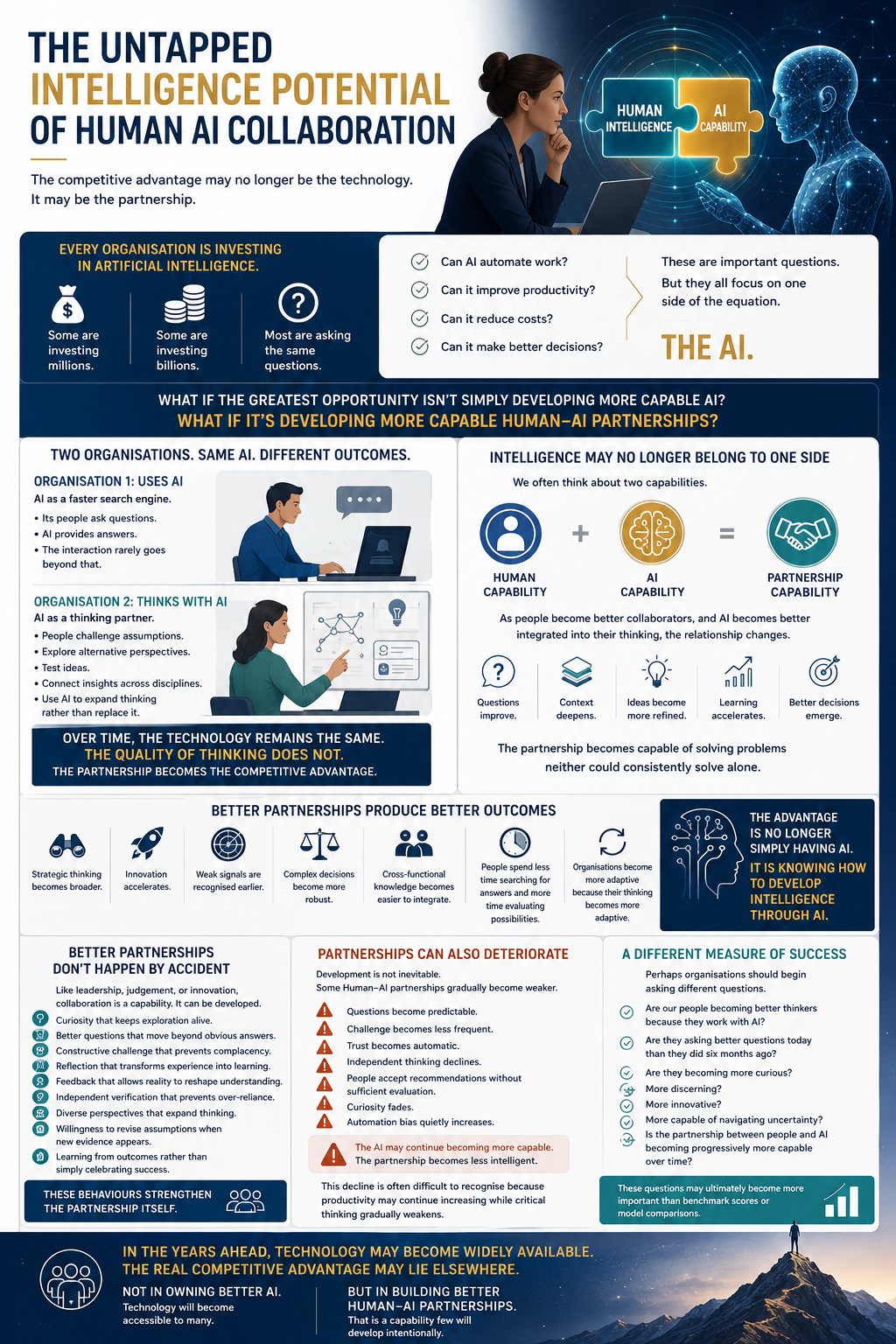
Every single day, major headlines tell us about the massive wave of money flowing into artificial systems. Look around the business world, and you will see that every organization is investing in artificial systems in one way or another. Some companies are investing millions of dollars into new software setups. Others are pouring in billions of dollars to build massive tech infrastructures.
When you sit in on corporate boardrooms or listen to industry leaders talk, you notice that most people are asking the exact same set of questions. They want to know:
Can automation handle our daily work?
Can it drastically improve our productivity?
Can it reduce our overhead costs?
Can it make better, faster decisions for our teams?
While these are undoubtedly important questions to consider, they all suffer from a major limitation. They focus entirely on just one side of the equation. They look exclusively at the technology itself.
What if we are missing the real story? What if the greatest opportunity of our generation is not simply developing more capable models? Instead, what if the true breakthrough lies in developing more capable Human AI partnerships?
When we change our focus from the tool to the relationship, the entire landscape changes. The ultimate competitive advantage for businesses may no longer be the underlying technology itself. To understand why this shift matters so much for everyday professionals, we have to look closely at how people actually interact with modern tools.
Imagine two different organizations using the exact same artificial platform. Because they pay for the same software subscription, they have access to the exact same models, the same digital tools, and the exact same pool of information. On paper, these two companies should perform at identical levels. However, their actual results could not be more different.
The first organization treats software as a faster search engine. When its employees need information, they type a quick question into a box. The system provides a rapid answer, the employee copies it into a document, and the interaction ends right there. It is a completely transactional process that rarely goes beyond basic data retrieval. The human remains passive, and the technology is treated like a fancy calculator.
The second organization builds something entirely different. Its people do not just use the software to skip the work of thinking. Instead, they actively learn how to think with these systems rather than simply using them to generate text.
In this second company, employees regularly use the system to:
Challenge their own deeply held business assumptions.
Explore completely alternative perspectives that they might have overlooked.
Test new ideas in a safe, simulated environment.
Connect unique insights across completely different disciplines.
Expand their overall depth of thinking rather than replacing human effort.
Over time, something truly remarkable happens inside that business. The underlying technology remains completely identical to what the competitor is using. The software has not received a special upgrade. Yet, the quality of human thinking inside the building changes dramatically. The human machine partnership itself becomes the true sustainable competitive advantage. You can buy the software, but you cannot buy the deeply ingrained habits of a team that knows how to think collaboratively.
In traditional discussions about the workplace, we often think about two separate capabilities. We talk about human capability, which includes our intuition, empathy, and years of real world experience. Then we talk about machine capability, which involves processing speed, pattern recognition, and massive data storage.
Perhaps there is a third capability that deserves far more of our attention. We need to start measuring the capability of the partnership itself.
As people become better collaborators, and as automated tools become more smoothly integrated into their daily thinking habits, the fundamental relationship changes. The conversation becomes a dynamic loop. Questions improve from basic commands to deep, layered inquiries. Context deepens because the human takes the time to explain the background situation.
As a result, business ideas become significantly more refined. Learning accelerates across the entire team, and far better decisions naturally emerge from the workflow. The partnership evolves to become capable of solving incredibly messy, complex problems that neither the human nor the machine could consistently solve completely alone. Capability is no longer a localized property that lives inside a single skull or a single server rack. It becomes a shared space that grows through interaction.
The overall quality of collaboration between employees and software influences almost every important business outcome you can measure. When an organization prioritizes the partnership rather than just the software installation, the positive ripple effects spread through every department.
First, strategic thinking becomes much broader. Instead of looking at past data patterns, leaders use collaborative prompts to explore wild scenarios, stress test their five year plans, and uncover hidden opportunities in the marketplace.
Second, innovation accelerates. Teams can rapidly prototype ideas, combining concepts from totally unrelated industries to create something completely novel. The machine acts as a massive sounding board that helps creative professionals break through mental blocks.
Third, weak signals in the market are recognized much earlier. When humans know how to guide systems to look for subtle anomalies in customer behavior or supply chains, the business can pivot long before a crisis hits.
Fourth, complex corporate decisions become far more robust. By intentionally using the machine to play devil’s advocate, management teams can uncover their own cognitive blind spots before launching a new product line.
Finally, cross functional knowledge becomes significantly easier to integrate. A marketing specialist can use a collaborative loop to quickly understand complex engineering data, allowing different teams to speak the same language seamlessly. People spend much less time searching for basic answers and far more time evaluating rich possibilities. Organizations become deeply adaptive because their collective thinking becomes adaptive. The real advantage is no longer simply having access to a model. It is knowing how to develop true capability through that model.
Like excellent leadership, sharp human judgment, or groundbreaking corporate innovation, true collaboration is a distinct capability. It is a muscle that must be intentionally trained. It can be systematically developed over time, or it can slowly decline through neglect and bad habits.
If you want to build a high performing human machine relationship, you must actively lean on specific developmental levers. These behaviors do much more than improve individual employee performance; they actively strengthen the partnership itself.
The Power of Lifelong Curiosity
Curiosity is the engine that keeps exploration alive in a world full of automated answers. When employees are genuinely curious, they do not accept the first paragraph of text a machine spits out. They keep digging, exploring side paths, and looking for unique angles that others miss.
Formulating Better Questions
The quality of what you get out of a collaborative tool depends entirely on what you put into it. Moving beyond obvious, one line answers requires learning how to ask open ended, layered questions that force the system to synthesize information rather than just repeat it.
Embracing Constructive Challenge
Complacency is the enemy of progress. A healthy partnership requires a culture of challenge, where the human regularly asks the system to justify its logic, provide alternative viewpoints, or find the flaws in its own recommendations.
Intentional Reflection
Speed is a major feature of technology, but it can cause us to move too fast. Reflection transforms rapid digital experience into lasting human learning. Taking ten minutes after a collaborative session to think about what worked and what failed ensures that your team actually gets smarter.
Continuous Reality Feedback
We must allow real world results to reshape our understanding. When an automated prediction turns out to be wrong, a healthy partnership uses that feedback to adjust the approach, ensuring that future digital collaborations are grounded in reality.
Independent Human Verification
Over reliance on technology is a fast track to operational failure. Teams must maintain independent verification protocols to check facts, audit data, and ensure that human accountability never takes a backseat to convenience.
Inviting Diverse Perspectives
True progress thrives on variety. Bringing diverse human backgrounds, distinct disciplines, and varied life experiences into the room changes how your team guides the software, resulting in much richer outputs.
Revising Core Assumptions
When fresh evidence appears during a collaborative research session, leaders must be completely willing to throw out old business playbooks and revise their underlying assumptions. Admitting a past framework no longer works is a sign of a developing partnership.
Learning from Real Outcomes
Instead of simply celebrating a quick success and moving on to the next task, mature teams study the entire process. They look at the outcomes of their decisions to understand exactly how the human and the machine worked together to achieve the goal.
We must recognize that positive development is not an inevitable law of nature. Some Human AI partnerships gradually become weaker, softer, and less capable over time. This decline is incredibly dangerous because it happens quietly in the background while your standard productivity metrics might still look amazing.
When convenience replaces active thought, questions become highly predictable and repetitive. Constructive challenge happens less and less frequently until it stops entirely. Trust in the software becomes completely automatic, and independent critical thinking rapidly declines. Employees begin to accept automated recommendations without any sufficient evaluation, letting their own analytical skills waste away.
As curiosity fades from the corporate culture, a subtle psychological phenomenon known as automation bias quietly takes over the office. People assume the computer is always right, so they stop paying close attention to their work.
In this tragic scenario, the underlying technology may continue becoming more capable with every new software update, but the overall partnership becomes less effective by the day. The company becomes a fast moving machine filled with passive button pushers who have outsourced their brains to an algorithm. If the system ever experiences a major glitch or encounters an unexpected market event, the workforce will be completely unprepared to take manual control of the business.
To avoid this trap, forward thinking organizations must begin asking a totally different set of questions. Instead of staring at software scorecards and comparing model benchmarks, executives should look directly at their human capital.
[ Old Tech Questions ]  ---> Can this software automate tasks and cut costs?
                                      vs.
[ New Team Questions ]  ---> Are our people becoming sharper thinkers via collaboration?
Every manager should regularly ask these simple, profound questions about their staff:
Are our people becoming better, more critical thinkers because they work alongside these systems?
Are our employees asking significantly better, more nuanced questions today than they did six months ago?
Are our team members becoming more curious and discerning in their daily research?
Is our workforce becoming more innovative and more capable of navigating high levels of uncertainty?
Is the ongoing partnership between our people and our technology becoming progressively more capable over time?
These qualitative questions will ultimately become far more important than any technical benchmark score or model comparison chart. The organizations that thrive in the coming decades will not simply be the ones that possess the most expensive, cutting edge systems. The true winners will be the companies that most intentionally develop the unique capability that emerges through the ongoing partnership between living people and increasingly capable software tools.
Advanced software is rapidly becoming a widely available utility, much like electricity or high speed internet access. In the very near future, access to raw technology will completely cease to be a meaningful competitive advantage. Increasingly, competing organizations will have direct access to the exact same foundational models, the exact same digital tools, and many of the exact same computational capabilities.
When everyone has access to the same smart tools, the true difference will lie entirely in how effectively your people work with them. The organizations that consistently outperform the market will not be those with the absolute smartest standalone software. They will be the ones whose people ask better questions, challenge weak assumptions more effectively, integrate cross disciplinary knowledge more intelligently, and continually improve the fundamental quality of their daily collaboration with technology.
This realization has massive implications that stretch far beyond simple workplace productivity. It directly affects:
Innovation: The ability to invent completely new products by blending human creativity with machine data.
Decision Quality: Making robust choices that survive messy, unpredictable, real world conditions.
Adaptability: Pivoting your entire business model smoothly when the global economy shifts.
Problem Solving: Unlocking answers to massive logistical or societal challenges that seemed impossible before.
Risk Management: Spotting structural vulnerabilities before they turn into expensive public disasters.
Learning: Helping junior employees gain deep industry intuition and advanced judgment at an accelerated pace.
Leadership: Guiding teams with clarity, empathy, and vision while utilizing digital insights.
Organisational Resilience: Building a business that can survive system outages, market corrections, and black swan events.
The future advantage will never come from a piece of software working in an empty room. True operational excellence will always come from intentionally developing the deep, shared power of the partnership. By treating technology as a collaborative peer rather than a simple labor replacement, we can unlock a massive wave of human growth that has remained completely untapped until now. The future does not belong to machines alone; it belongs to the teams that learn how to think beautifully together.