
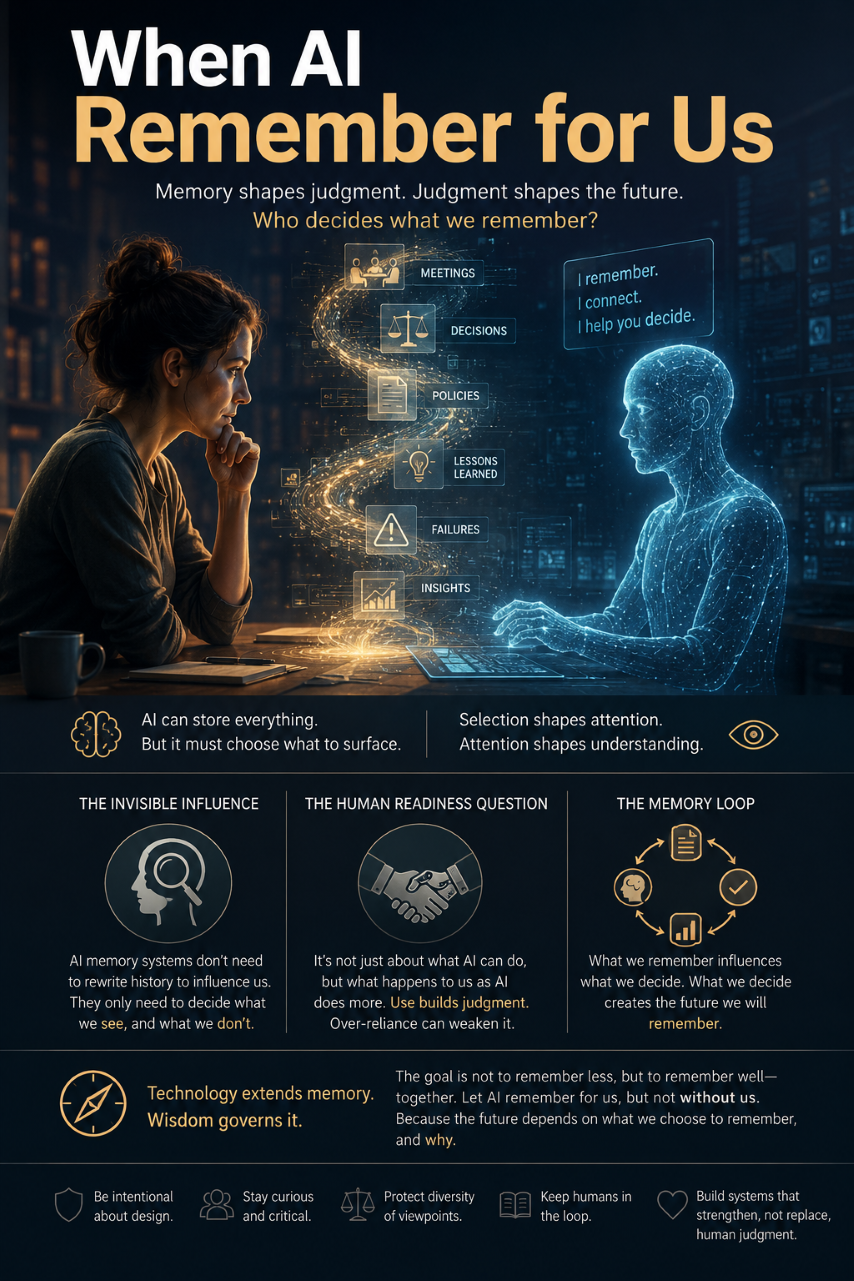
Remember how we used to store knowledge? We remember how individuals remember, how communities remember, and how institutions remember our shared past. We remember how cultures remember stories, and we remember how companies remember records. Today, we must remember that technology alters memory. Do you remember when search engines changed what we remember? We must remember that AI will not simply store what we remember. Instead, AI decides what is brought forward, forcing us to remember that selection shapes human thought. We must remember the hidden human consequence of machine-mediated memory.
For much of human history, memory has been understood as something we possess. Technology has progressively expanded our ability to store those memories outside ourselves. Writing did it. Libraries did it. Databases did it. Search engines did it.
Artificial intelligence may represent something fundamentally different. Because increasingly, AI will not simply store what we recall. It will participate in deciding what gets retrieved, what becomes relevant, what is brought forward, what recedes from attention, and which parts of the past become available to shape the present.
That changes the problem. The question is no longer simply: Can AI remember accurately? A deeper question is emerging: What happens to human judgment when machines increasingly mediate what we recall?
Human beings have never made decisions from complete information. We interpret reality through what is available to us: what we recall, what others tell us, what records survive, and what experiences remain salient. Memory therefore does more than preserve the past; it helps construct the informational environment from which the present is interpreted.
This matters because increasingly sophisticated AI memory systems may become active participants in constructing that environment. An AI assisting an organization might eventually have access to years of decisions, meetings, policies, customer interactions, and strategic reasoning. No human could meaningfully hold all of this simultaneously.
The AI therefore has to select, and selection changes everything.
[ Stored Memory ] ──► Information preserved deep in the archive system
[ Available Memory ] ──► Information retrieved and presented by the AI
[ Influential Memory ] ──► Information that actually shapes human judgment
This introduces a governance problem that may be easy to overlook. AI systems do not need to falsify history to influence human judgment; they need only repeatedly determine which history receives attention.
Imagine an organization where AI becomes extraordinarily effective at retrieving precedent. Decision making becomes faster, and previous reasoning becomes readily available. Everything appears to improve. Yet gradually, people search less independently. They encounter fewer unusual precedents, and historical dissent receives less attention.
Information remains preserved, but interpretive possibility becomes narrower. That is a Human Readiness problem.
Human Readiness asks a critical question: What happens to human capability as the AI becomes increasingly capable? Human capabilities are not static possessions. Judgment, discernment, and contextual reasoning develop through active use.
If AI increasingly performs the work of retrieving, organizing, and contextualizing institutional history, humans gain extraordinary informational capability. But we must also ask what skills they may gradually stop practicing.
AI-mediated memory is recursive. Consider the circular sequence:
Past information flows into AI selection.
AI selection shapes human interpretation.
Human interpretation leads to decisions and new actions.
New actions create fresh records in the system.
Future AI retrieval relies on these expanded records to guide future choices.
The greatest danger does not occur when AI memory performs badly, because people notice missing information and intervene. The real risk arises when AI memory becomes extremely good. As trust increases, independent verification decreases. Humans can gradually exercise less agency simply because exercising it appears increasingly unnecessary.
Healthy memory requires forgetting, but once forgetting becomes computationally mediated, who determines what deserves to disappear? Governance of memory cannot concern itself only with preservation; it must concern itself with recoverability, contestability, and interpretive diversity.
Human cognitive sovereignty means preserving sufficient human capacity to question what is presented, seek what is absent, recognize uncertainty, and challenge dominant interpretations.
The objective is not to preserve memory exactly as it existed before AI, but to preserve the conditions through which human judgment can continue developing alongside powerful tools. As AI becomes capable of storing our past, we must intentionally preserve the human capacity to decide what is truly worth holding onto.