
Changes happen rapidly in modern organizations, and these changes reshape daily decision workflows. When changes alter how teams operate, leadership must analyze how these changes affect human capability. Every system changes user behavior over time, while behavioral changes dictate future operational success. Sudden changes in escalation rates signal deeper changes in employee confidence. Operational changes demand careful oversight, as subtle changes in review habits can create unexpected risks. Recognizing these changes early protects critical thinking, while systemic changes redefine organizational memory. Understanding how technology changes human judgment ensures these changes deliver sustainable performance. Embracing these changes keeps enterprises resilient.
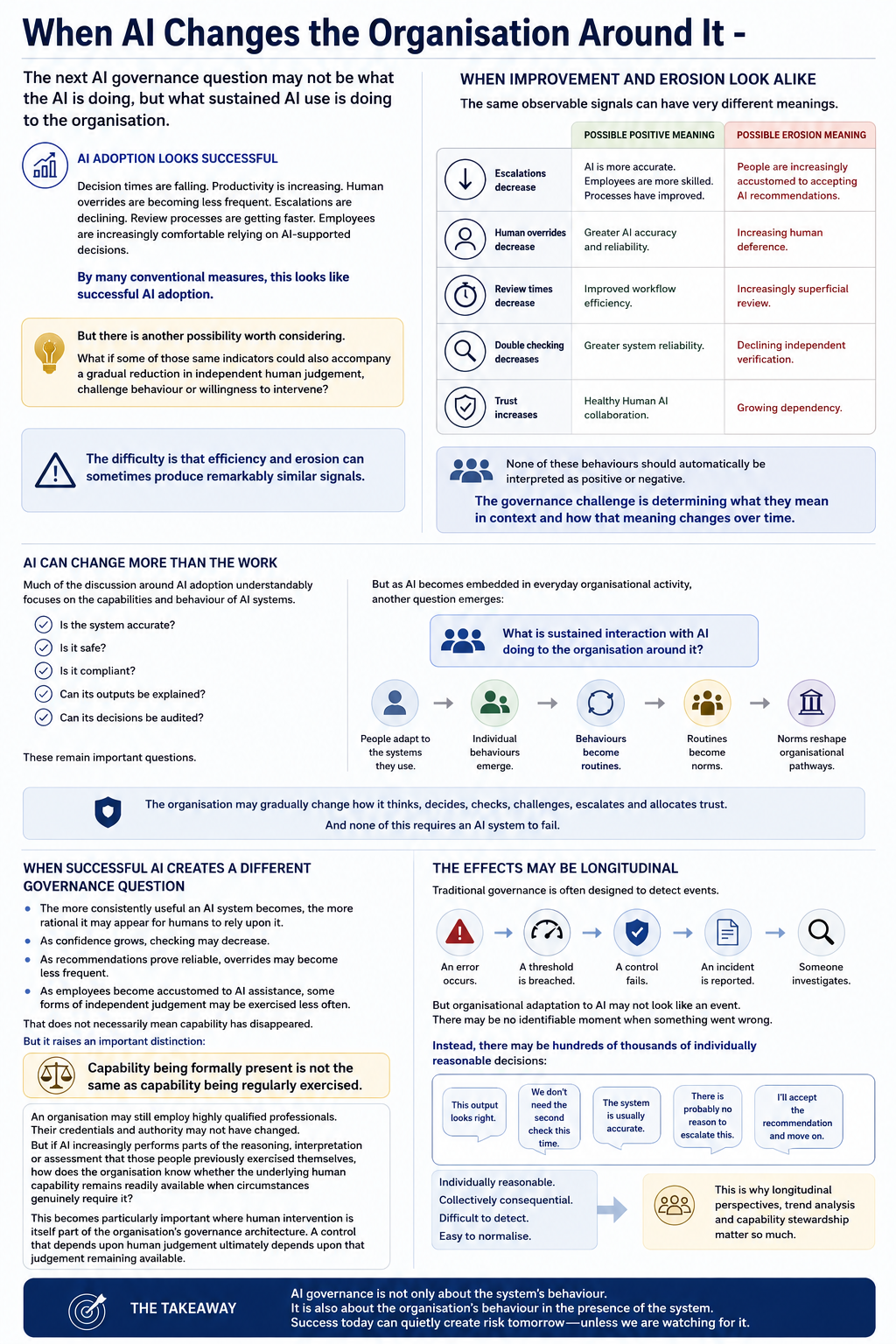
Imagine an organization where AI adoption appears to be going extremely well. Decision times are falling. Productivity is increasing. Human overrides are becoming less frequent. Escalations are declining, and review processes are getting faster. Employees are increasingly comfortable relying on AI supported decisions.
By many conventional measures, this looks like successful AI adoption.
But there is another possibility worth considering. What if some of those same indicators could also accompany a gradual reduction in independent human judgment, challenge behavior, or willingness to intervene? The difficulty is that efficiency and erosion can sometimes produce remarkably similar signals.
Consider something as simple as declining escalation rates. There are several reasons this might happen:
The AI may have become more accurate.
Employees may have become more skilled at using it.
Processes may have improved and fewer cases genuinely require escalation.
All of those would be positive developments. But escalation might also decline because people have become increasingly accustomed to accepting AI recommendations. The observable result is the same: escalations decrease. The meaning is entirely different.
The same ambiguity can appear elsewhere. Fewer human overrides might indicate greater AI accuracy, or increasing human deference. Faster review times might indicate improved workflow efficiency, or increasingly superficial review. Less double checking might reflect greater system reliability, or declining independent verification.
None of these behaviors should automatically be interpreted as positive or negative. The governance challenge is determining what they mean in context and how that meaning changes over time.
2. Organizational Changes Beyond the Work
Much of the discussion around AI adoption understandably focuses on the capabilities and behavior of AI systems. Is the system accurate? Is it safe? Is it compliant? Can its outputs be explained? Can its decisions be audited?
These remain important questions. But as AI becomes embedded in everyday organizational activity, another question emerges: What is sustained interaction with AI doing to the organization around it?
People adapt to the systems they use. They learn when to trust them, when to check them, when to challenge them, when to escalate, and when to defer. Initially, these may simply be individual behaviors. Repeated across thousands of interactions, however, behaviors become routines. Routines become norms. Norms can eventually reshape organizational pathways.
[ Individual Behavior ] ──► [ Operational Routine ] ──► [ Cultural Norm ] ──► [ Pathway Shift ]
The organization may gradually change how it thinks, decides, checks, challenges, escalates, and allocates trust. And none of this requires an AI system to fail.
3. How Behavioral Changes Mask Critical Risks
There is an interesting paradox here. The more consistently useful an AI system becomes, the more rational it may appear for humans to rely upon it. As confidence grows, checking may decrease. As recommendations prove reliable, overrides may become less frequent. As employees become accustomed to AI assistance, some forms of independent judgment may be exercised less often.
That does not necessarily mean capability has disappeared. But it raises an important distinction: Capability being formally present is not the same as capability being regularly exercised.
An organization may still employ highly qualified analysts, engineers, accountants, clinicians, managers, or other professionals. Their credentials have not changed. Their authority may not have changed. But if AI increasingly performs parts of the reasoning, interpretation, or assessment that those people previously exercised themselves, how does the organization know whether the underlying human capability remains readily available when circumstances genuinely require it?
4. The Longitudinal Tracking of Behavioral Changes
Traditional governance is often designed to detect events. An error occurs, a threshold is breached, a control fails, or an incident is reported. But organizational adaptation to AI may not look like an event. There may be no identifiable moment when something went wrong.
Instead, there may be hundreds of thousands of individually reasonable decisions:
This output looks right.
We do not need the second check this time.
The system is usually accurate.
There is probably no reason to escalate this.
I will accept the recommendation.
Each decision may be perfectly defensible. The interesting question is what happens when these behaviors accumulate over months or years.
This is Enterprise Pathway Drift: gradual changes in organizational decision pathways, checking behaviors, escalation patterns, challenge practices, trust allocation, and human capability that emerge through sustained interaction with AI. Drift does not necessarily mean deterioration, as AI should remove unnecessary work and improve decisions. The challenge is distinguishing healthy adaptation from gradual erosion.
Healthy Adaptation: AI removes friction ──► Humans focus on high level strategy
Gradual Erosion:    AI removes friction ──► Humans stop verifying assumptions
5. Measuring Changes Through Internal Data
Organisations may not always need entirely new forms of data to begin asking these questions. Evidence may already exist across operational systems:
Escalation Histories: Show how frequently people seek additional judgment.
Override Records: Reveal changing patterns of human disagreement with automated recommendations.
Review Logs: Show whether verification behavior is changing.
Exception Records: Reveal emerging workarounds.
Workflow Histories: Show where decision pathways are compressing.
Qualitative Evidence: Reveals changing patterns of trust, confidence, and willingness to challenge.
Individually, none of these measures tells us whether an organization is becoming more capable or less capable. Together, and observed longitudinally, they tell a much richer story.
6. Overcoming the Visibility Problem
The people who notice organizational change first may not be the people with authority to respond to it. A junior analyst may notice that colleagues rarely question AI recommendations anymore. A frontline employee may see an unofficial workaround becoming normal practice. A supervisor may notice that a review step still formally exists but is treated as a formality.
[ Frontline Workers ]  ──► Direct visibility into daily drift, but limited authority
                                       vs.
[ Senior Leadership ]  ──► High authority to act, but receives only aggregated metrics
Senior leaders have authority but frequently see aggregated information. Frontline workers have direct visibility but limited authority. Governance must create better pathways between observation, evidence, interpretation, and authorized human decision making.
None of this replaces existing AI governance. Accuracy, safety, compliance, bias, security, explainability, and technical reliability matter. But increasingly capable AI requires observing the human organization adapting around it.
That means asking questions that conventional AI performance measures may not answer:
Are people challenging AI differently than they did a year ago?
Are escalation pathways still being used?
Is independent verification increasing or decreasing?
Are different teams developing different relationships with the same AI systems?
Are experienced and junior employees adapting in the same way?
Are human capabilities being strengthened, displaced, or simply exercised less frequently?
Would the organization recognize the difference between becoming more efficient and becoming more dependent? Some of the most consequential effects of AI adoption do not initially appear as failures; they appear as improvements.
As AI becomes increasingly embedded in organizational decision making, governance must look beyond whether AI systems continue to perform well. We must understand what prolonged interaction with those systems is gradually doing to the humans, behaviors, and decision pathways around them.