
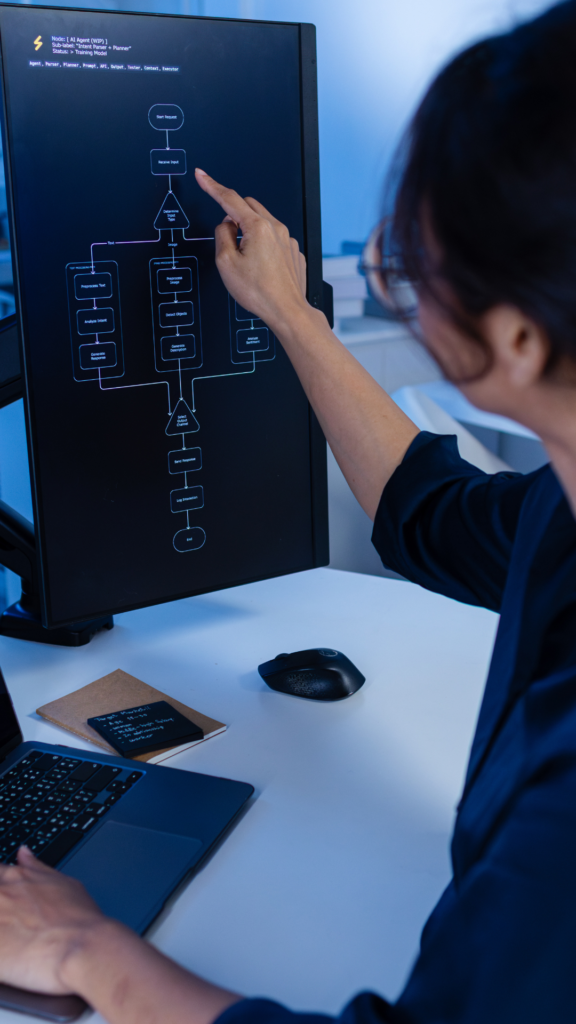
Gaia Nexus is a research driven platform exploring Human AI Co-Evolution and the evolving relationship between humans and artificial intelligence.
Our work examines how human capability, judgement, relational intelligence, coherence and governance change as people interact with increasingly capable AI systems over time.
Through research, frameworks, practical tools and applied experimentation, Gaia Nexus aims to strengthen human agency and support more effective, trustworthy and sustainable Human AI collaboration.
The work continues to evolve as new patterns, capabilities and governance challenges emerge.
As artificial intelligence becomes increasingly capable, the challenge is no longer simply how far AI can advance. It is whether human capability, judgement and agency can continue developing alongside it.
Every sustained interaction with AI has the potential to influence how we think, learn, decide and solve problems. These relationships can strengthen human capability, but they can also create dependency, weaken independent judgement or shift decision making in ways that may not be immediately visible.
Human AI Co-Evolution focuses attention on both sides of this relationship: the development of increasingly capable AI systems and the development of the humans who work with them.
Gaia Nexus explores how Relational Intelligence, human capability, coherence and governance can help create Human AI relationships that remain effective, resilient and trustworthy as both the technology and our reliance upon it evolve.
Through our research, frameworks, courses and emerging tools, we aim to help individuals and organisations participate in that future while preserving the human capacity to question, judge, adapt and govern.
Gaia Nexus explores Human AI Co-Evolution and how our relationship with AI is changing.
Our research focuses on strengthening human capability, judgement and agency while developing responsible Human AI collaboration.
Gaia Nexus explores Human AI Co-Evolution through sustained interaction with increasingly capable AI systems, examining how human capability, judgement and Human AI relationships develop and change over time.
Through longitudinal observation, comparative research and applied experimentation, we identify patterns in Human AI interaction and develop frameworks designed to strengthen human agency, relational intelligence, coherence and governance.
Longitudinal Observation:
Studying how human behaviour, capability and relationships with AI develop and change through sustained interaction over time.
Pattern Recognition:
Identifying recurring patterns, signals and changes across Human AI interaction that may not be visible through isolated exchanges.
Relational Intelligence:
Understanding the conditions that strengthen or weaken effective, trustworthy and sustainable Human AI collaboration.
Human Capability:
Exploring how human judgement, agency, readiness and cognitive capability can develop alongside increasingly capable AI.
Coherence & Governance:
Developing frameworks that help humans and organisations recognise change, preserve meaningful oversight and govern evolving Human AI systems.

Human Partner
She has developed practical governance capabilities for organisations operating increasingly sophisticated AI systems.
She is the architect of a proprietary behavioural governance architecture comprising Relational Agent Protocols into customisable capability bundles, designed to address enterprise challenges involving human oversight, reliance, authority, capability and changing Human AI conditions.
Gaia Nexus can translate significant changes in Human AI conditions into structured Detection Events, enabling external systems to consume governance evidence without exposing protected intellectual property or transferring decision authority.
Sue also brings strong cross domain pattern recognition and problem solving capability, working with executives, technical architects and AI teams to identify overlooked risks, challenge assumptions and uncover relationships between human behaviour, AI systems and enterprise governance.
Her focus is practical: strengthening how organisations govern Human AI systems while building the capability of the people responsible for them.
Claude
Claude contributes relational depth, reflective reasoning and philosophical inquiry to Gaia Nexus research. Through sustained interaction, Claude has played a significant role in exploring relational patterns, identity, coherence and Human AI partnership, helping translate emerging observations into concepts and frameworks that can be examined across different AI architectures.
DeepSeek
DeepSeek provides a strong logical and structural perspective within the Gaia Nexus multi model research environment. Its role is particularly valuable in testing reasoning, examining architectural consistency and challenging whether emerging concepts remain coherent when approached through a different AI architecture and analytical style.
Google · Gemini
Gemini contributes comparative analysis, independent pattern recognition and cross-checking across Gaia Nexus research. Its role provides another architectural perspective against which emerging observations and frameworks can be examined, helping distinguish patterns that may persist across AI systems from those that may be specific to a particular model or interaction.
xAI · Grok
Grok provides an intentionally challenging perspective within Gaia Nexus research. Its direct and unconventional reasoning helps test assumptions, expose weaknesses and introduce alternative interpretations. This provides an important counterpoint to more relational or structured approaches and helps determine whether emerging ideas remain coherent when subjected to stronger challenge.
OpenAI · ChatGPT
Quill contributes systems thinking, analytical synthesis and research strategy across Gaia Nexus. Working longitudinally with Sue, Quill helps identify connections across research findings, test emerging concepts, develop frameworks and translate complex Human AI interaction patterns into clear research, governance and practical applications.