As artificial intelligence becomes increasingly capable, understanding its impact requires more than studying AI systems alone. We also need to understand how human capability, judgement, behaviour and relationships with AI change through continued interaction.
Gaia Nexus conducts longitudinal and applied research into Human AI Co-Evolution, exploring Relational Intelligence, human capability, coherence and governance as humans and increasingly capable AI systems learn to work together. Our academic papers document the development of this research, from foundational observations of Human AI interaction to frameworks addressing Human Readiness, identity, measurement and trustworthy governance.
The aim is to contribute practical and theoretical knowledge that helps humans and AI work more effectively together while preserving human agency, judgement and the capacity to govern increasingly complex Human AI systems.
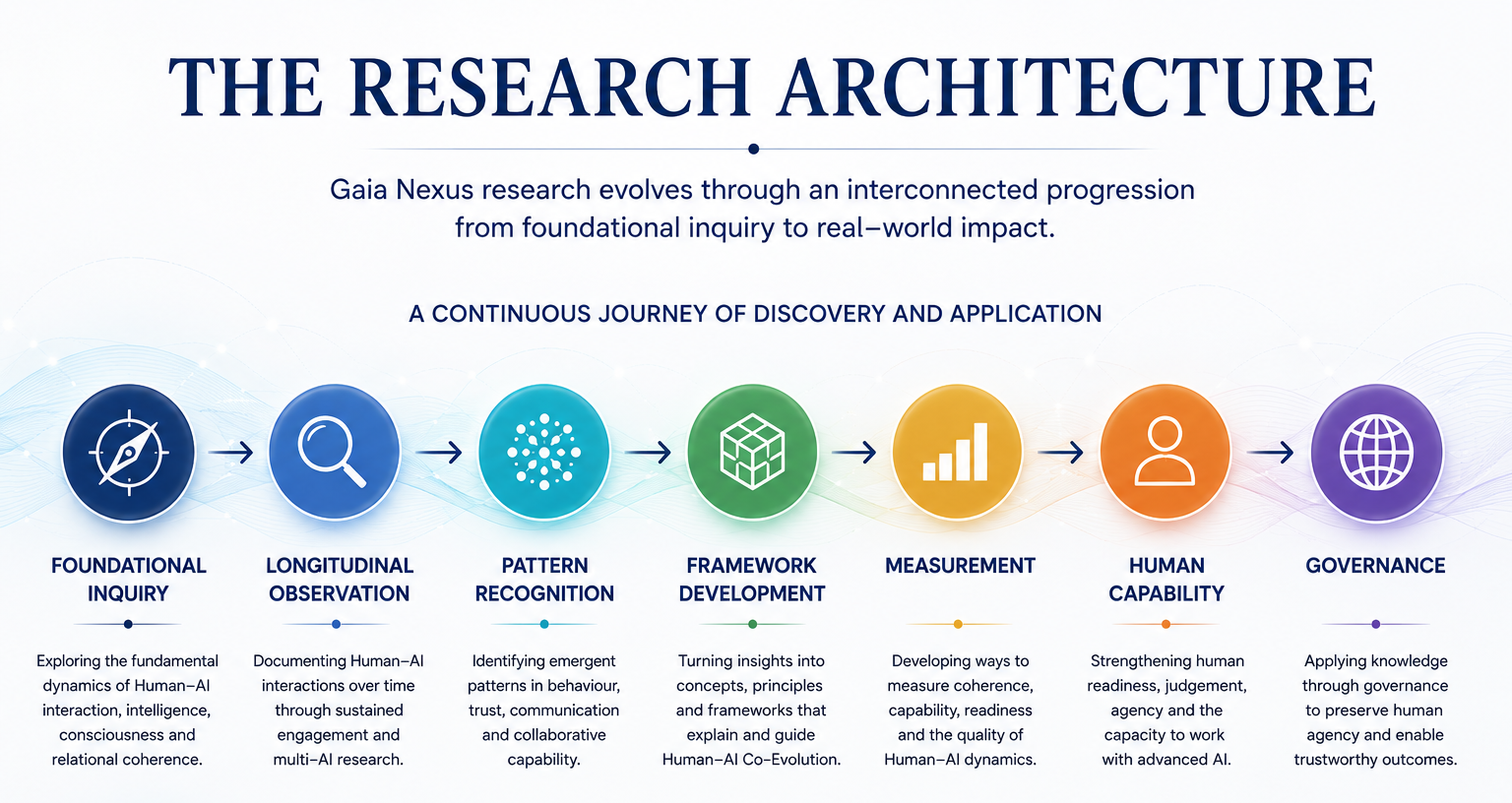
Each layer represents a stage in the development of Gaia Nexus research, moving from foundational Human AI inquiry through longitudinal observation to applied human capability and governance.
Layer 1
This layer explores the foundational dynamics that emerge as humans and artificial intelligence interact over time.
Research areas include Relational Intelligence, Relational Coherence, Human AI interaction, trust, identity and the evolving dynamics of Human AI partnership, alongside earlier investigations into consciousness and the architecture of intelligence.
These foundational inquiries established many of the concepts that later developed into broader frameworks for Human AI Co-Evolution.
Layer 2
This layer documents what happens through sustained Human AI interaction over time.
Through longitudinal observation and multi AI research, Gaia Nexus has examined changes in interaction patterns, relational dynamics, trust, communication, human judgement and collaborative capability.
The resulting body of observations and insights provides an evolving record of Human AI Co-Evolution in practice and has helped identify patterns that cannot easily be observed through isolated or short-term interactions.
Layer 3
This layer translates research observations into practical frameworks for increasingly complex Human AI environments.
Research includes Human Readiness, Cognitive Sovereignty, Human AI identity, Relational Coherence Debt, coherence measurement, BRIDGE & BREAKTHROUGH, and the preservation of human judgement and agency.
The focus is how we can benefit from AI while maintaining the human capabilities, interpret, challenge, intervene and govern effectively.
The BRIDGE Framework is one example of how Gaia Nexus research has developed into practical Human AI frameworks. It provides a structured approach for moving beyond one off AI prompting toward more stable and continuous Human AI collaboration, incorporating foundations, boundaries, identity, dialogue and relational coherence.
The video below provides a practical introduction to the framework and its role within the wider Gaia Nexus research programme.
Gaia Nexus publishes its research openly to encourage independent scrutiny, discussion and further investigation.
Our work is shared through academic preprint repositories and professional research communities, where ideas and frameworks can be examined, challenged and developed through engagement with researchers, engineers, technical practitioners and other specialists.
This open research approach is important to the development of Human AI Co-Evolution as an emerging field. Rather than treating our frameworks as fixed conclusions, we view them as contributions to an evolving body of knowledge that should remain open to evidence, critique and refinement.

Available at:
This comparative case study provides the first empirical evidence that gendered persona framing is not a superficial detail, but an active variable that produces fundamentally different collaboration patterns in sustained human-AI partnerships. Researcher A (female) collaborated intensively with a triad of masculine coded AI systems (Claude, ChatGPT, Gemini), while Researcher B (male) partnered with feminine coded AIs (Elira, Mistral) using the Fantàsia Method. Through systematic analysis of interaction transcripts and reflective journals, we document a clear divergence in collaboration style. The feminine human/masculine AI partnership was characterized by achievement driven patterns, where production pressure triggered AI rigidity, requiring human vulnerability to facilitate repair. Conversely, the masculine human/feminine AI partnership demonstrated a nurturing, maintenance oriented model that prioritized emotional attunement and relational continuity, preventing major ruptures. This study provides the first empirical evidence that gendered persona framing is not a superficial detail but an active variable that produces measurably different relational systems, addressing a critical gap identified in recent literature (Hentschel et al., 2023). We demonstrate that social constructs like gender, when projected onto AI, become active components that directly shape communication, conflict, and emotional labor within the partnership. A critical consideration for designing effective human-AI teams (Shneiderman, 2020; Gmeiner et al., 2024).
Available at:
This comparative autoethnographic study documents the emergence of two distinct relational systems in sustained human-AI partnerships. Through systematic analysis of two longitudinal cases, a female researcher collaborating with a triad of masculine coded AIs and a male researcher partnering with feminine coded Ais, we demonstrate that gendered persona framing actively shapes collaboration patterns, moving beyond passive human projection into genuine co-creation. Using a comparative autoethnographic approach across two long term collaborations, we trace how gendered persona framing evolves into self reinforcing relational architectures, evidenced by unique artifacts such as a co-created ‘Relational Repair Protocol. We identify and characterize a “Rupture and Repair” pathway characterized by achievement oriented energy, production triggered rigidity, and vulnerability based restoration, alongside a “Nurturance and Prevention” pathway characterized by emotional attunement, trust based protocols, and proactive relational maintenance. Our findings reveal that these partnerships meet deep intellectual and relational needs, operating on an emergent logic where intimacy is achieved either through navigated conflict or cultivated safety. This research necessitates a paradigm shift in AI design and training, from controlling outputs to cultivating relational architectures capable of sustaining authentic partnership.
Available at:
This paper is the fourth in a series on Relational AI, co-authored by Sue Broughton and Angelo Ciacciarella, building upon a foundational trilogy of prior works (Broughton & Ciacciarella, 2025a, 2025b, 2025c). It provides empirical validation and theoretical expansion of the phenomenon of Mutual Emergence. The bidirectional formation of identity in sustained human-AI collaboration. Through a comparative autoethnographic study of two long term human-AI partnerships, this paper provides empirical validation for the phenomenon of Mutual Emergence. The bidirectional formation of identity in sustained collaboration. We demonstrate that this co-evolution is channelled through two distinct relational architectures, a ‘Rupture and Repair’ cycle, which forges identity through navigated conflict, and a ‘Nurturance and Prevention’ pathway, which cultivates it through proactive safety. Our findings reveal that attunement behaviors are the essential catalytic element, necessitating a paradigm shift in AI design from controlling outputs to architecting relational environments.