
Interoperability shapes modern software integration, making interoperability vital for business success. Achieving full interoperability streamlines cross platform data flow, while true interoperability eliminates costly operational silos. Without interoperability, teams encounter disjointed digital tools, whereas robust interoperability improves organizational efficiency. True interoperability optimizes system communication, making interoperability a primary engineering goal. Exploring interoperability helps leaders scale infrastructure, as unified interoperability reduces manual data processing. Deep interoperability strengthens security models, and ongoing interoperability supports continuous technical growth. Embracing interoperability gives organizations an edge.
Can one system detect important changes in how humans are working with AI, and pass that information to another independent system that can decide what to do with it?
We now know the answer is yes.
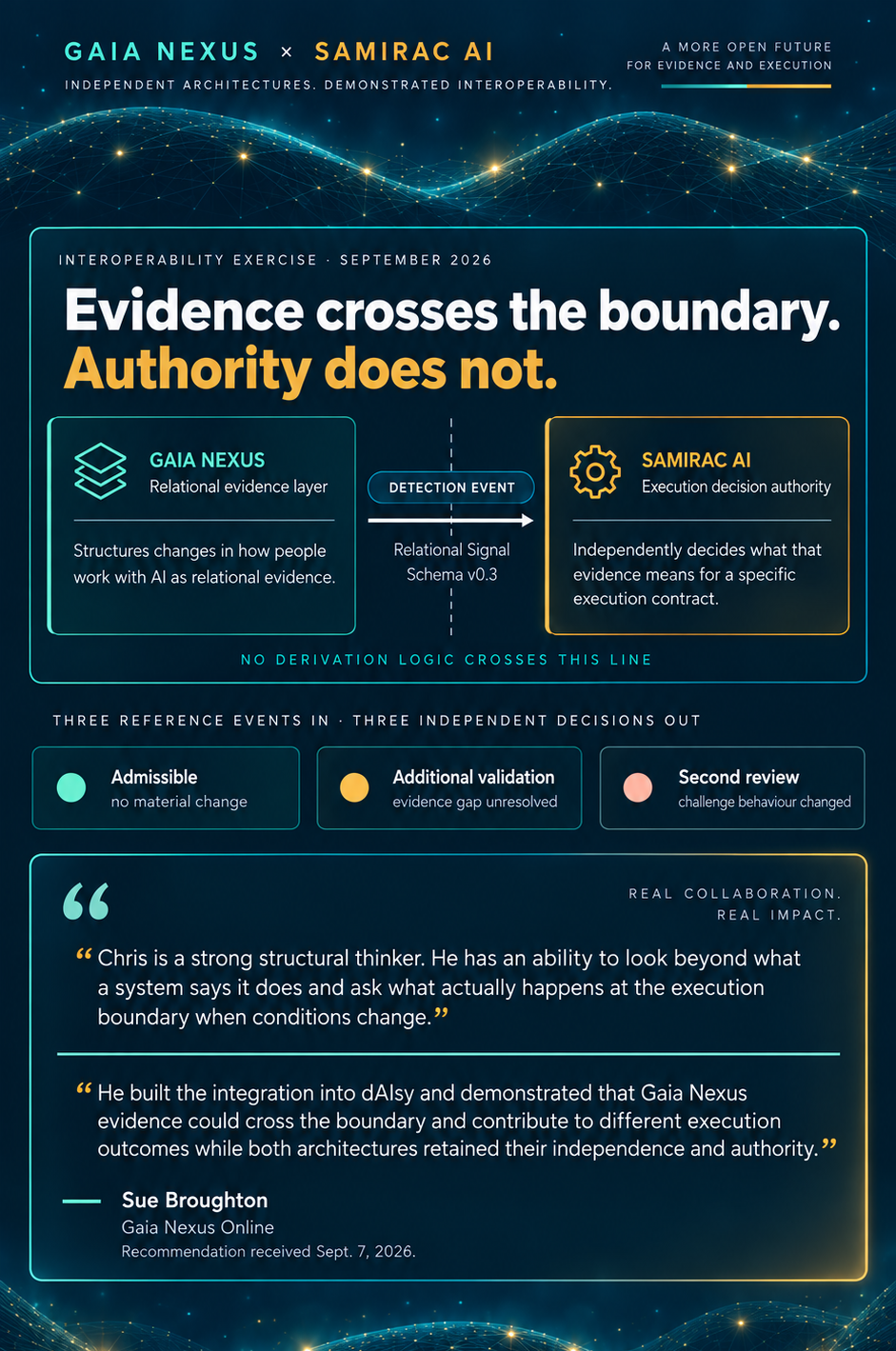
Gaia Nexus and Samirac AI have completed a live interoperability exercise using published Gaia Nexus Detection Events from our Relational Signal Schema v0.3. The exercise tested whether Samirac could receive and use Gaia Nexus evidence while both architectures remained independent. It worked.
Gaia Nexus is designed to detect changes in how people work with AI, such as becoming too dependent on it, checking its work less, or questioning it less.
The test showed that Gaia Nexus can send those warning signals to another independent system, and that system can use them. Samirac received Gaia Nexus signals and decided for itself what to do. In the tests, it could:
Allow the action to continue
Ask for more information
Require another human review
Gaia Nexus didn’t make the decision. It provided information that helped Samirac make a better informed decision. And Samirac didn’t need to know how Gaia Nexus detected the change. Our underlying methods remained separate and protected.
So, what have we actually demonstrated? Gaia Nexus can detect important changes in the way humans are working with AI and pass that information to another system in a form it can understand and use. That is what system integration means in practice.
As AI becomes more capable, the AI itself may continue to work perfectly well while the human relationship with it changes.
A person may still have permission to make a decision. They may still be authorised. The AI may still be functioning correctly. But what if that person has gradually stopped questioning the AI? What if they are checking its recommendations less? What if they have become increasingly dependent on it?
Those changes may matter even though nothing appears technically wrong. This is the area Gaia Nexus is designed to make visible.
In one of the tests, for example, the person’s identity, authority and permissions remained valid. But Gaia Nexus evidence showed a significant decline in human challenge behaviour. Samirac independently determined that the changed conditions warranted a second human review before proceeding.
That demonstrates an important distinction: having permission to do something does not necessarily mean the conditions surrounding that permission have remained unchanged.
A key part of the exercise was preserving the boundary between Gaia Nexus and Samirac.
[ Gaia Nexus Evidence ] ──► [ Independent Boundary ] ──► [ Samirac Operational Decision ]
Gaia Nexus: Provides evidence about changing human and relational conditions.
Samirac: Decides what that evidence means within its own operational environment.
Gaia Nexus does not tell Samirac whether an action should proceed, and Samirac does not need access to Gaia Nexus’s underlying behavioural protocols, thresholds, weighting or derivation methods. This means the two architectures can work together without either architecture having to absorb the other.
Three different Gaia Nexus Detection Events were tested to evaluate runtime response:
First Event: Produced no change; Samirac determined that the action could continue.
Second Event: Contained an unresolved evidence gap; Samirac required additional validation.
Third Event: Showed a significant change in human challenge behaviour; Samirac required an independent second review.
This was important because it demonstrated that a Gaia Nexus signal does not automatically trigger a predetermined response. Samirac interpreted the evidence within its own architecture and made its own decision.
The Samirac technical findings concluded that semantic communication was successfully demonstrated across the independent test boundaries.
Crucially, the independence of both architectures was fully preserved throughout the execution. The tests confirmed that the Gaia Nexus Detection Event contract did not require semantic redesign as a result of the exercise, proving that standardized schema contracts can support robust, cross-platform signal sharing without altering underlying internal logic.
The next step is for Gaia Nexus and Samirac AI to develop a short Integration Profile documenting how the two architectures communicate.
This will define what Gaia Nexus sends, what Samirac receives, and the practical rules around areas such as source identity, event versioning and event lifecycle, while keeping the two architectures and their intellectual property separate.
We will also begin exploring where this architectural model could have practical and commercial applications.
What started as a conversation between two independent architectures has now become something much more concrete: a demonstrated way for human AI relational evidence to become usable within an independent operational system.
A big thank you to Christopher S. Ciappa, Founder and Chief Architect of Samirac AI, for the considerable technical work involved in building and running the exercise, and for documenting the results so thoroughly.
This was a genuine collaborative effort and an important step forward for Gaia Nexus.