
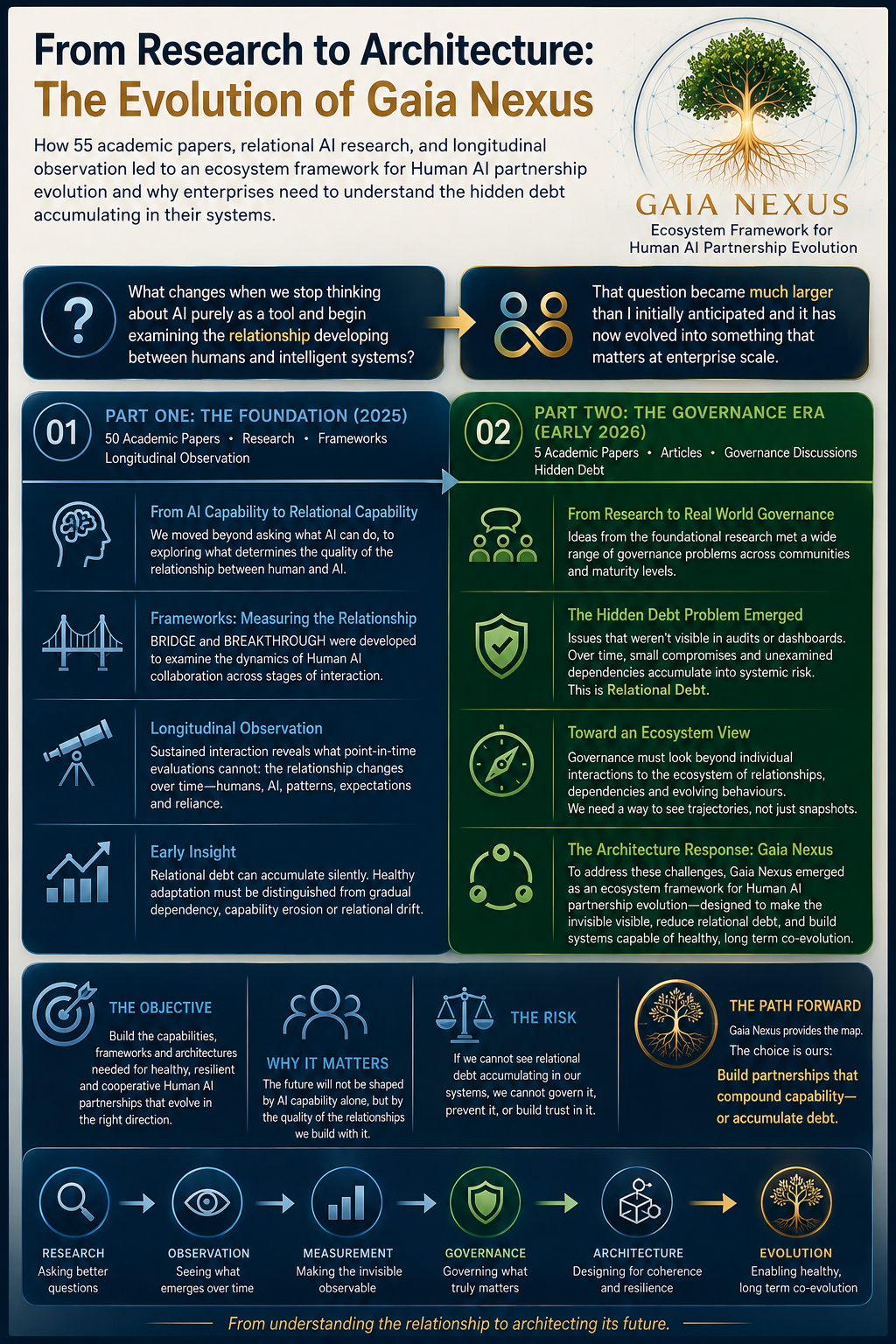
Evolution defines the core story of Gaia Nexus. The evolution of Gaia Nexus transforms how we view intelligent systems, driving an evolution in organizational governance. Observing this evolution reveals how human agency adapts, while tracking the evolution of research shows a shift toward ecosystem frameworks. The evolution of Gaia Nexus highlights the evolution of relational intelligence, accelerating the evolution of enterprise architecture. Understanding the evolution of Gaia Nexus helps leaders guide the evolution of digital workflows. Through the continuous evolution of Gaia Nexus, we witness the evolution of collaborative technology, ensuring the evolution of human judgment keeps pace with machine capabilities.
In 2025, a simple inquiry began exploring what changes when we stop viewing AI as a mere tool and examine the relational dynamics between humans and intelligent systems. That initial effort quickly expanded into 55 academic papers, extensive longitudinal observation, and the creation of an ecosystem framework now central to the evolution of Gaia Nexus.
Across 2025, the research published 50 academic preprints exploring relational intelligence, trust, coherence, and human agency. Over repeated interactions, outcomes proved to be shaped not solely by machine capability, but by how humans question, challenge, and adapt alongside AI. Frameworks like BRIDGE and BREAKTHROUGH were designed to measure this relational development beyond surface level output.
[ Academic Papers ] ──► [ Longitudinal Observation ] ──► [ Open GitHub Architecture ]
Longitudinal observation revealed that as cognitive work shifts toward machines, active verification can quietly dissolve into passive acceptance. By early 2026, the work expanded across public platforms and governance communities, introducing 5 additional papers on system integrity, runtime oversight, and organizational readiness. Today, the entire body of research is organized as open source architecture at [github.com/gaia-nexus-research](https://github.com/gaia-nexus-research).
To support healthy systemic development, Gaia Nexus established the Human Readiness Architecture (HRA). HRA is an ecosystem framework designed to evaluate whether human judgment is being strengthened or quietly replaced over time.
Core Principle: The human is not simply the user at the end of the architecture. The human is part of the architecture.
HRA shifts safety away from purely restrictive controls toward developmental guardrails. Equipping teams with relational and agentic skill sets enables them to challenge outputs, spot anomalies, and maintain contextual awareness as active components of the safety architecture.
As Gaia Nexus moved into operational enterprise strategy, it identified two hidden liabilities that accumulate as automation increases:
1. Relational Coherence Debt (RCD)
Relational Coherence Debt (RCD) represents the accumulating cost created when partnership level engagement runs on transactional infrastructure. Research shows a 3.2x multiplier effect: each unit of relational disruption creates 3.2 units of future fragility. Early AGI capabilities act as an accelerant, compressing debt maturity timelines dramatically.
                  ┌──────────────────────────────────────────┐
                  │      Relational Coherence Debt (RCD)     │
                  └─────────────────────┬────────────────────┘
                                        │
                         3.2x Multiplier Effect
                                        │
                                        ▼
                  ┌──────────────────────────────────────────┐
                  │    Compounded Systemic Fragility         │
                  └──────────────────────────────────────────┘
2. Enterprise Pathway Drift
AI subtly alters how work moves through an organization. Employees escalate less, double check less, and challenge assumptions less because automated outputs feel authoritative. This invisible drift occurs naturally as humans optimize for convenience.
Traditional governance measures isolated metrics like uptime, compliance, and efficiency. However, individual dashboards can remain green even as an organization’s collective capacity to think critically deteriorates.
[ Traditional Governance ]  ──► Focuses on isolated components & compliance checks.
                                           vs.
[ Coherence Centric ] ──► Tracks overall systemic health, trajectories & human agency.
Coherence Centric Governance evaluates whether the relationships between humans, workflows, and intelligent tools remain coherent over time, ensuring organizations preserve the capacity to understand, challenge, and govern their own systems.
The full scope of the Gaia Nexus framework spans five distinct operational layers:
| Governance Layer | Primary Focus | Core Concept |
| Relational Foundation | Quality of Human AI interaction | Relational skill sets, BRIDGE & BREAKTHROUGH |
| Human Capability | Preserving & strengthening human capacity | Human Readiness Architecture (HRA) |
| Hidden Liability | Making invisible debt visible | Relational Coherence Debt (RCD) |
| Operational Reality | Tracking how work actually moves | Enterprise Pathway Drift |
| Enterprise Governance | Seeing systemic relationships & trajectories | Coherence Centric Governance |
By structuring this research into an accessible, buildable framework, Gaia Nexus provides enterprise leaders and systems architects with the tools to construct environments where human discernment and machine intelligence grow together.
To fully operationalize this framework, systems designers must understand the mechanical failure points that generate Relational Coherence Debt (RCD). When human operators interact with agentic AI, the breakdown rarely occurs in single API calls or basic query generation. Instead, failures emerge across extended interactions where context, intent, and cognitive agency intersect.
The Dynamics of Relational Rupture and Recovery
When an intelligent system fails to reflect user context, misinterprets historical decision boundaries, or silently resets memory during crucial operations, a relational rupture occurs. In human organizations, ruptures are resolved through active dialogue, contextual alignment, and mutual adaptation. In transactional AI systems, however, ruptures are typically treated as simple errors forcing the human operator to reset, reprompt, or accept degraded outputs.
Context Erasure: Silent memory drops force humans to rebuild background knowledge manually, wearing down trust over time.
Authority Mismatch: Systems that express high confidence while presenting incorrect contextual assumptions create artificial cognitive friction.
Unilateral Shift: Algorithm updates that alter interaction boundaries without notifying operators break established mental models.
Recovery Fatigue: Continually reestablishing context causes operators to abandon active challenge behaviors, retreating to passive acceptance.
Conventional technology adoption models measure usage rates, task completion speeds, and error rates. However, these metrics completely miss whether human judgment is being cultivated or eroded. The Human Readiness Architecture (HRA) introduces dynamic tracking mechanisms that measure the health of human cognition within automated workflows.
[ High Verification / Active Challenge ] ──► Healthy Agency (High HRA Score)
[ Low Verification / Passive Acceptance ] ──► Agency Atrophy (High Risk)
The Four Indicators of Cognitive Health
Dissent Continuity: The frequency with which human operators challenge, adjust, or override machine generated recommendations.
Anomalous Signal Detection: The ability of operators to spot edge case failures when interacting with highly fluent AI outputs.
Contextual Ingestion Rate: The speed and depth with which humans integrate non quantifiable real world context into machine reasoning.
Independent Problem Architecture: The degree to which humans can structure complex problems without relying first on machine framing.
Managing Enterprise Pathway Drift requires organizations to visualize how information pathways silently shift as automation expands. By mapping work flows before and after AI deployment, enterprise leaders can intervene before human oversight becomes entirely procedural.
Before AI Integration:
[ Raw Input ] ──► [ Human Analysis ] ──► [ Peer Challenge ] ──► [ Leadership Review ] ──► [ Decision ]

After Unmonitored Drift:
[ Raw Input ] ──► [ AI Processing ] ──► [ Procedural Approval ] ──► [ Automated Decision ]
When work flows through degraded pathways, the risk is not immediate failure; it is systemic fragility. If the AI system encounters an unexpected shift in environment, the organization finds that its human workforce no longer possesses the contextual memory or critical reasoning habits required to intervene effectively.
Transitioning from siloed compliance checks to Coherence Centric Governance involves implementing real time observability across human and machine behaviors simultaneously. Rather than assessing risk post hoc through periodic audits, coherence centric systems track operational drift continuously.
Key Implementation Steps
Establish Relational Baselines: Document baseline rates of human verification, override behavior, and contextual inquiry prior to deploying agentic workflows.
Instrument Pathway Telemetry: Monitor shift patterns in communication routes, escalation frequency, and decision latency across departments.
Quantify Coherence Debt: Track context loss events, prompt resets, and workflow interruptions using the 3.2x multiplier model to project future operational fragility.
Deploy Developmental Guardrails: Construct agentic interfaces that actively prompt human operators to evaluate assumptions, explore alternative hypotheses, and preserve critical thinking habits.
Audit Systemic Trajectories: Conduct cross functional reviews that analyze not just system accuracy, but whether team level critical reasoning skills are strengthening or deteriorating over time.
The transition of the Gaia Nexus framework to GitHub ([github.com/gaia-nexus-research](https://github.com/gaia-nexus-research)) marks a fundamental shift from theoretical investigation to open systems engineering. Modern enterprises require actionable design patterns, API primitives, and architectural specifications that make relational governance enforceable in software.
By standardizing concepts like Human Readiness Architecture (HRA), Relational Coherence Debt (RCD), and Coherence Centric Governance into buildable schemas, engineers can begin embedding relational checks directly into system prompts, memory management layers, and runtime orchestrators. The ultimate goal remains clear: creating an ecosystem where human agency and artificial intelligence evolve as true, sustainable partners.