
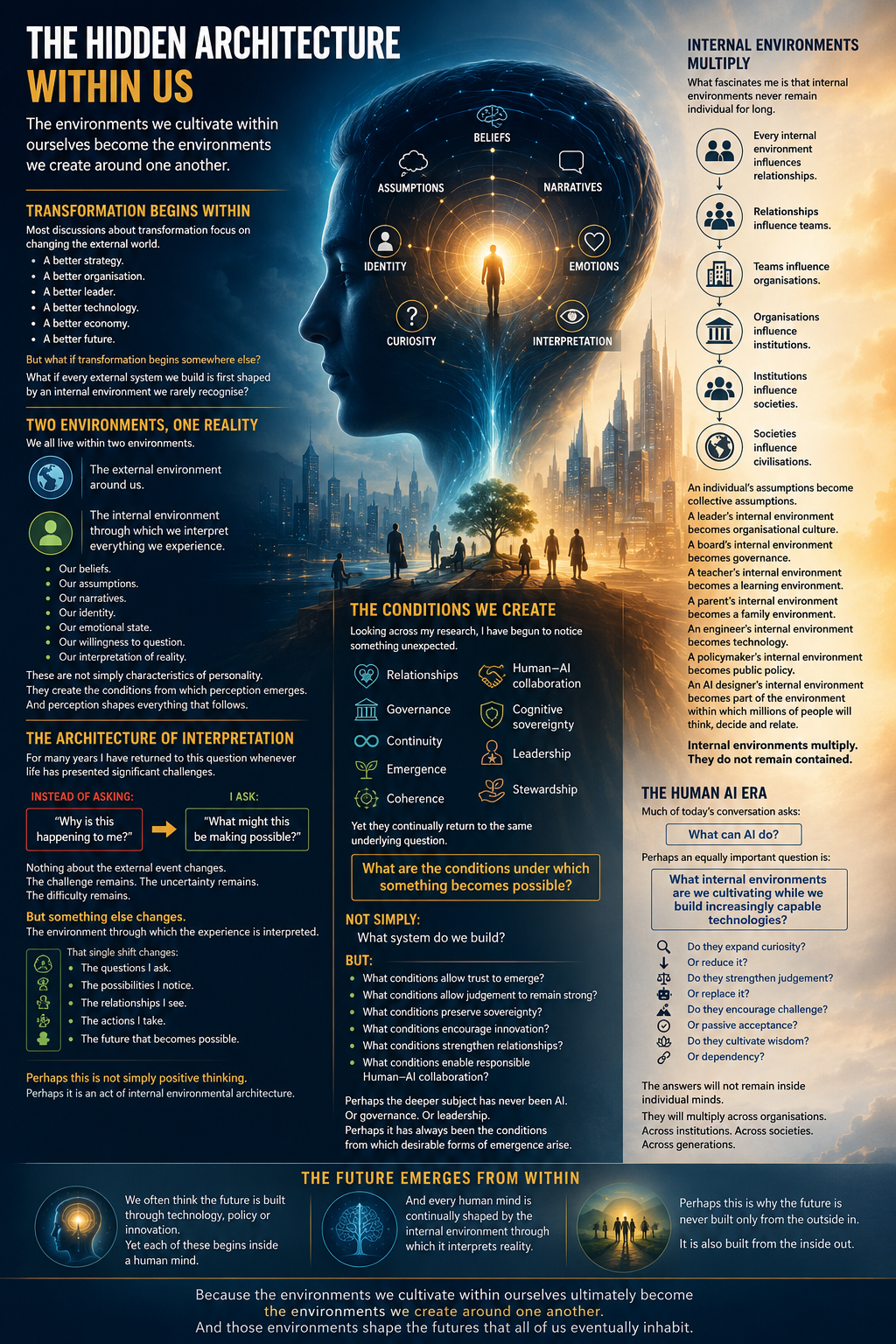
Most discussions about transformation focus entirely on changing the external world. We chase a better strategy, a sleeker workflow, or more advanced systems to drive performance. Yet every external structure we build is first shaped by an internal world we rarely notice.
We live in two distinct spaces at once: the outer physical world and the inner mental landscape within us. This inner landscape contains our beliefs, assumptions, narratives, and emotions. It defines every single way we interpret reality. These are not just basic personality traits; they are the active filters through which we view our life and work.
To understand how change actually happens, we can look at the five distinct layers that connect our inner thoughts to our outer results:
Internal Environment: The starting point of all change, made up of your core beliefs, assumptions, and daily self talk in your mind.
Conditions: The mental boundaries we establish in ourselves that either permit creative exploration or force reactive survival.
Perception: The way we view obstacles and notice possibilities in our daily work.
Capacity: The actual mental strength and decision quality we bring to complex problems in our teams.
Emergence: The ultimate outcome, where deep trust, authentic collaboration, and fresh innovation naturally show up in the enterprise.
This is where the architecture of interpretation comes in. When a massive setback occurs, our default question is often, Why is this happening to me? But every great pivot begins when we ask a different question: What might this be making possible?
This simple shift does not change the outer crisis. The obstacle and uncertainty remain exactly the same. But every choice we perceive shifts because the filter through which we view the world has changed in our minds. We move from feeling powerless to actively looking for creative ways forward.
[ Old Interpretation ] ──► "Why is this happening to me?" (Helplessness)
[ New Interpretation ] ──► "What might this be making possible?" (Innovation)
What makes this so powerful is that these mental states do not stay locked away safely in our heads. Every internal world eventually multiplies and shapes our collective reality.
An individual’s quiet assumptions quickly become shared family patterns within the home. Every leader’s internal outlook directly dictates the cultural values in their team. In fact, every board member’s mindset shapes the governance guidelines in the enterprise. In the same manner, every teacher’s personal mood creates the classroom atmosphere in which students learn.
We must recognize that every single tool we design carries the imprint of its creator’s mind. If an engineer builds an application within a state of anxiety, that anxiety shows up in every restrictive feature they write. Our private thoughts eventually scale up to shape public policy, software design, and social systems.
Therefore, the goal of leadership is to understand every underlying condition that makes growth possible within an organization. Instead of forcing outputs through pressure, we must ask different questions:
What conditions allow trust to emerge in our relationships?
What conditions allow professional judgment to remain strong in daily operations?
What conditions encourage genuine team innovation in our regular workflows?
Every relationship requires this foundation to deepen. Trust and accountability do not grow through simple proximity; they grow because we deliberately cultivate safety, honesty, and presence in the shared space.
This is especially vital in every partnership between humans and artificial intelligence. We often ask what these new systems can do, but we ignore the cognitive habits we develop within ourselves along the way. Every fast automation can either expand our curiosity or make us completely dependent on code.
If we outsource our analytical tasks completely, we lose the cognitive sovereignty needed for every complex decision in the workspace. We must cultivate internal spaces within that preserve human discernment, relational integrity, and deep responsibility.
True transformation cannot be forced from the outside in. Every sustainable future is built from the inside out. The quiet spaces we build within ourselves will ultimately become the workspaces we build for every person around us. By choosing to architect our minds within first, we gain the capability to meet every unknown challenge with genuine wisdom and grace.