
Flipping the Frame: Why We Need a New Way to Manage AI Model in the Workplace
Discover how a new model for artificial intelligence governance can change your workplace. Learn why traditional safety frameworks are failing and how this fresh approach prevents team burnout and costly mistakes.
Model operations are changing fast. Every single day, millions of professionals log into their computers and begin a silent conversation. They type a question into an artificial intelligence system, review the answer, tweak it, and move on to the next task. This is no longer the era of basic technology where we simply click a button and get a standard output. We have crossed a major threshold into an era of deep, continuous collaboration. We are working alongside artificial intelligence as true partners, allowing it to shape how we think, what we notice, and what we consider possible. Yet, as these partnerships become central to our daily operations, implementing a modern model for oversight is the only way to truly know if these relationships are healthy.
Right now, the way businesses try to manage artificial intelligence is fundamentally incomplete. Most corporate oversight frameworks are built around a single, defensive question: is the system moving away from its original parameters? This traditional model treats artificial intelligence like a machine on a factory floor, constantly checking to see if a gear has slipped or if the output has changed from day one. While tracking these technical changes is certainly important, it ignores the human half of the equation. It assumes that as long as the computer is functioning perfectly, the overall work environment is perfectly safe. Traditional tracking only looks for failures after they happen, completely missing the subtle signs of breakdown that occur under heavy workloads long before a major error ever registers on a dashboard. This is why a more comprehensive management model has become so vital for modern enterprises.
The Invisible Problem with Traditional Safety Models
When organizations focus exclusively on whether a system has changed its baseline performance, they create three compounding blind spots that threaten long term operational stability. The first limitation is that this traditional model has no positive definition of operational health. It can easily tell you when something goes wrong, but it cannot tell you what a flourishing, highly effective human partnership looks like. Without a clear target for what a healthy relationship looks like, organizations have no way to design better systems, measure performance improvement, or justify the investments they make in their internal infrastructure. Effective management solves this by establishing a positive model of health from the start.
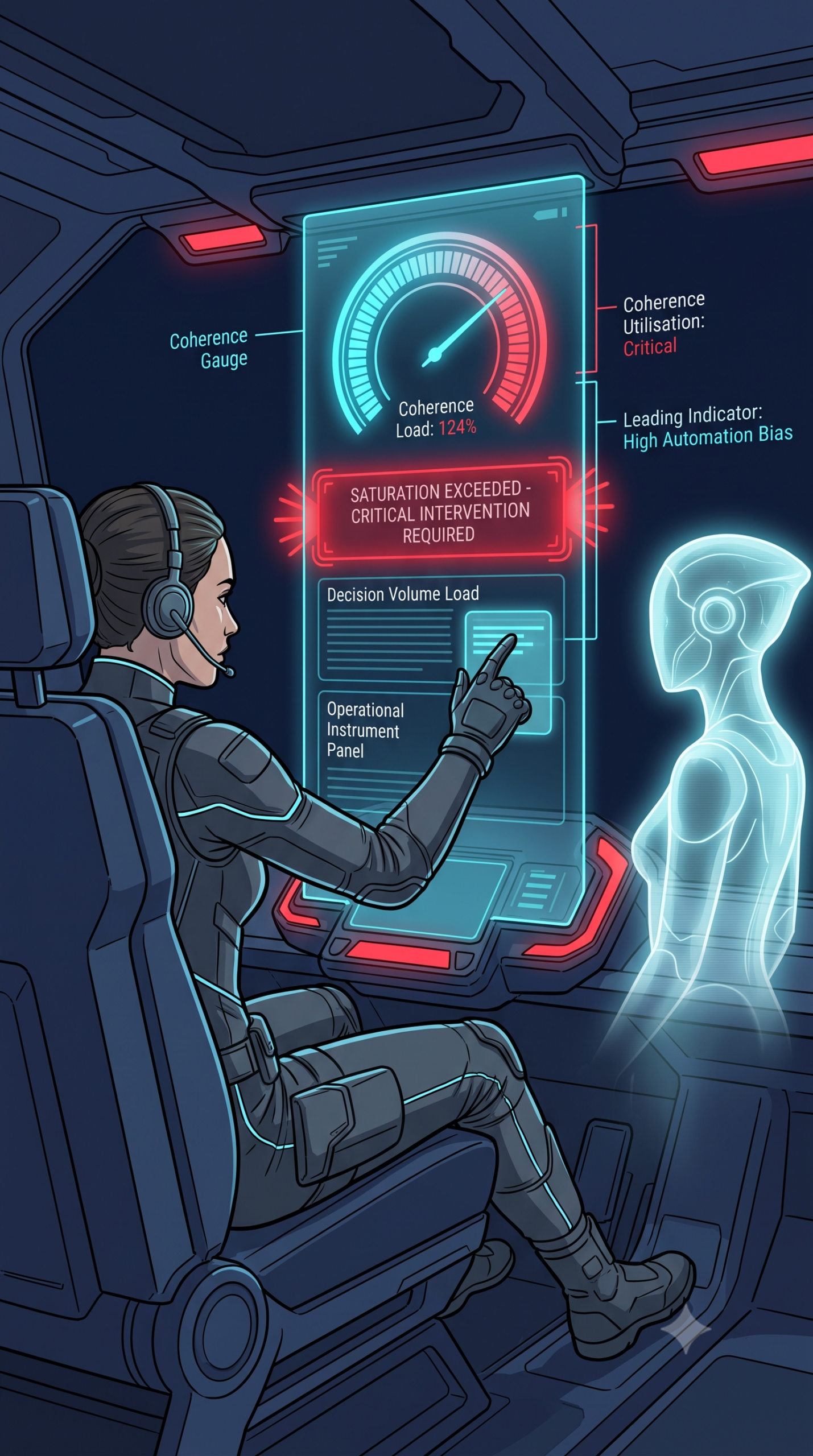
The second and most critical blind spot is the complete omission of workload pressure. In any real world operational environment, the volume of tasks changes everything. Consider a doctor seeing five patients a day compared to a doctor seeing fifty patients a day. The medical professional will behave completely differently under that massive increase in demand. Think about a pilot flying once a week versus a pilot flying five complex corporate sectors in a single day. The same rule applies to office workers interacting with artificial intelligence. A human team handling three automated recommendations a day will carefully scrutinize every detail. That same team handling three hundred recommendations a day will inevitably change their behavior. When the volume of demand exceeds human capacity, human oversight collapses, overrides disappear, workers stop verifying the computer outputs, and a deep reliance on automation takes over. This is not a failure of employee values or a lack of professional discipline. It is a pure capacity failure, and a standard compliance model has no tools to see it coming.
The third limitation is the inability to distinguish between positive evolution and silent degradation. When a human and an artificial intelligence work together over many months, their relationship will naturally change. Through a traditional lens, any change looks like a deviation from the original norm. However, that change could represent two completely different paths. It could mean the partnership is evolving beautifully, with the human discovering creative new ways to leverage the system. Or it could mean the relationship is decaying, with the human slowly losing their core skills and blindly trusting the software. A robust oversight model must be able to tell the difference between these two trajectories before the loss of human capability becomes completely irreversible.
Bringing Workforce Planning to the World of AI
To fix this broken model, we have to look outside the field of computer science and draw upon a discipline that businesses have understood for decades: workforce planning. In a typical corporate environment, manager scheduling, call center management, and emergency room staffing are all driven by clear metrics. A customer service center is never judged solely by whether its agents are polite. It is judged by whether the staffing levels can handle the incoming call volumes without causing employee burnout or service collapse. Every high stakes environment, from aviation flight decks to financial trading floors, builds its entire strategy around capacity and load management.
Yet, when it comes to implementing artificial intelligence, this proven framework is completely ignored. Executives often deploy automated systems across entire departments, watching transaction speeds skyrocket while assuming that the human staff will seamlessly keep up with the review process. This creates a dangerous condition where a team might be operating at a significant deficit in their oversight capacity, meaning human verification is actively failing. This is not a theoretical concern. It is a measurable, manageable operational risk. The central question for modern business leaders is simply whether they have installed the right model to see it.
A Complete Four Layer Architecture for Modern Business
To shift from a defensive posture to a sustainable framework, organizations need a comprehensive management system that serves as a practical instrument panel for managers and board members. This specific model organizes operational oversight into four distinct, interdependent layers:
Without the addition of the fourth layer, capacity and load, the first three layers remain purely philosophical guidelines rather than practical tools. When you introduce capacity tracking into your operational model, you suddenly create something that corporate boards can actively fund, managers can easily run, and operational teams can use in their daily routines. It allows an organization to apply the exact same discipline it uses for regular staffing to the human artificial intelligence partnership itself, intervening long before operational service levels collapse.
The Five Metrics Every Leader Needs to Track
One of the primary reasons this relational health concept has remained abstract in business discussions is that it historically lacked concrete, operational metrics. To bridge the gap between academic theory and practical corporate leadership, we must translate these ideas into the exact language that executives already use for budget planning, burnout risk assessment, and service level agreements. Five core metrics provide this clarity for your management model:
To make these metrics actionable, leaders can look to behavioral leading indicators. These are early warning signals that show saturation is approaching long before an operational crisis occurs. One major indicator is the Override Decay Rate, which tracks how often humans actively contest or correct system outputs. If this rate plummets, it is a clear sign that workers are experiencing automation bias and simply accepting whatever the computer generates. Another vital signal is Review Time Compression, which measures the average time spent reviewing each automated output. A sharp decline here shows that employees are rubber stamping results rather than performing genuine reviews. Additionally, Confidence Divergence tracks the widening gap between software confidence scores and calibrated human judgment, signaling an underlying misalignment. Finally, the Error Acceptance Rate measures the percentage of planted test errors that human reviewers miss entirely, providing an objective view of oversight fatigue.
A Fundamental Shift in the Corporate Worldview
Moving from a traditional framework to a health centered approach requires a complete evolution in how an organization thinks about technology and human resources. The old model views the computer as a mere tool to be monitored via surveillance and correction, casting the human as a compliance enforcer whose main job is catching errors. The new model treats the relationship as a true partnership, casting the human as a partner whose capacity must be actively protected. Traditional approaches invest heavily in rigid guardrails and post incident detection systems, asking only: are we safe right now? The health centered model invests in comprehensive onboarding, structural recovery periods, and professional development, asking: are we healthy, sustainable, and growing for the long term?
This perspective does not replace traditional safety checking. Rather, it adds the critical missing layers of capacity visibility and workload management. It provides a positive blueprint for building corporate partnerships that can sustain themselves under intense industry pressure. It changes what an organization builds, shifting investments away from purely restrictive compliance gates and moving toward a model focused on robust capacity forecasting and dedicated recovery windows. Risk assessment shifts away from focusing solely on rare, catastrophic failures, recognizing that everyday capacity saturation is the far more immediate and probable threat to corporate performance.
The Cost of Accumulating Relational Debt
When organizations ignore the health of these workplace interactions, an invisible liability begins to mount on a balance sheet that most corporate executives have not even opened. This hidden liability is relational debt, the growing gap between what complex automated workflows require from humans and what corporate operating systems actually provide. This debt compounds silently across an enterprise until it manifests as significant financial and operational costs. Without a proactive management model, this debt can quickly spiral out of control.
In the short term, everyday users experience intense frustration, a breakdown of trust in their digital tools, and disruptive errors. Organizations absorb these consequences through high employee turnover, massive IT support overhead, and a failure to realize the productivity gains they were promised. In the medium term, as these unmanaged partnerships multiply across various departments, systemic disruptions emerge. Internal learning fails to propagate, and core institutional knowledge begins to atrophy at scale. In the long term, the businesses that deployed automation most aggressively without building a balanced human infrastructure will find themselves carrying the heaviest burden of debt, facing massive financial costs to recover their lost workforce capabilities.
An Action Plan for Sustainable Progress
This framework is absolutely not a call to slow down the adoption of modern technology or pause digital transformation initiatives. It is an urgent call to build the internal infrastructure that makes those deployments sustainable for the human beings running the business.
Traditional safety systems tell an organization when to hit the brakes after danger appears. A health centered model shows a business how to build an engine that functions perfectly under pressure, ensuring long term success in the modern digital landscape.