
Business leaders everywhere are excited about artificial intelligence. They’re investing millions to automate tasks, speed up decisions, and boost productivity. But in the rush to adopt AI, many companies are asking the wrong questions or at least, only half the right ones. They focus on finding a simplified path to efficiency, without considering the long term cost.
They focus on: Is the AI accurate? Is it secure? Does it comply with regulations? Is it delivering results?
These are important. But there’s a quieter, more dangerous risk hiding in plain sight. As AI gets better at suggesting answers, people can slowly stop thinking for themselves. Over time, human judgment the very thing that should guide the technology starts to weaken.
This is not science fiction. It’s already happening in organisations that appear highly successful on the surface. The AI looks smart. The reports look impressive. Yet the people responsible for final decisions are becoming less engaged, less challenging, and less capable of stepping in when something goes wrong.
At Gaia Nexus, we believe successful AI adoption isn’t just about the technology. It’s about ensuring your people stay strong, sharp, and fully in control. This article explains the hidden problem in simplified terms and shows how Gaia Nexus helps organisations solve it.
The Problem: AI Is Winning, But Humans Are Quietly Stepping Back
Imagine a busy executive team. Every morning, an AI system delivers recommendations for pricing, inventory, hiring, or customer offers. At first, managers carefully review the suggestions. They challenge assumptions, add context from their experience, and make informed decisions.
Six months later, the simplified process has completely changed. The AI recommendation arrives. Managers glance at it, click approve, and move on to the next task. Why? Because the AI is usually right, the process is faster, and everyone is busy.
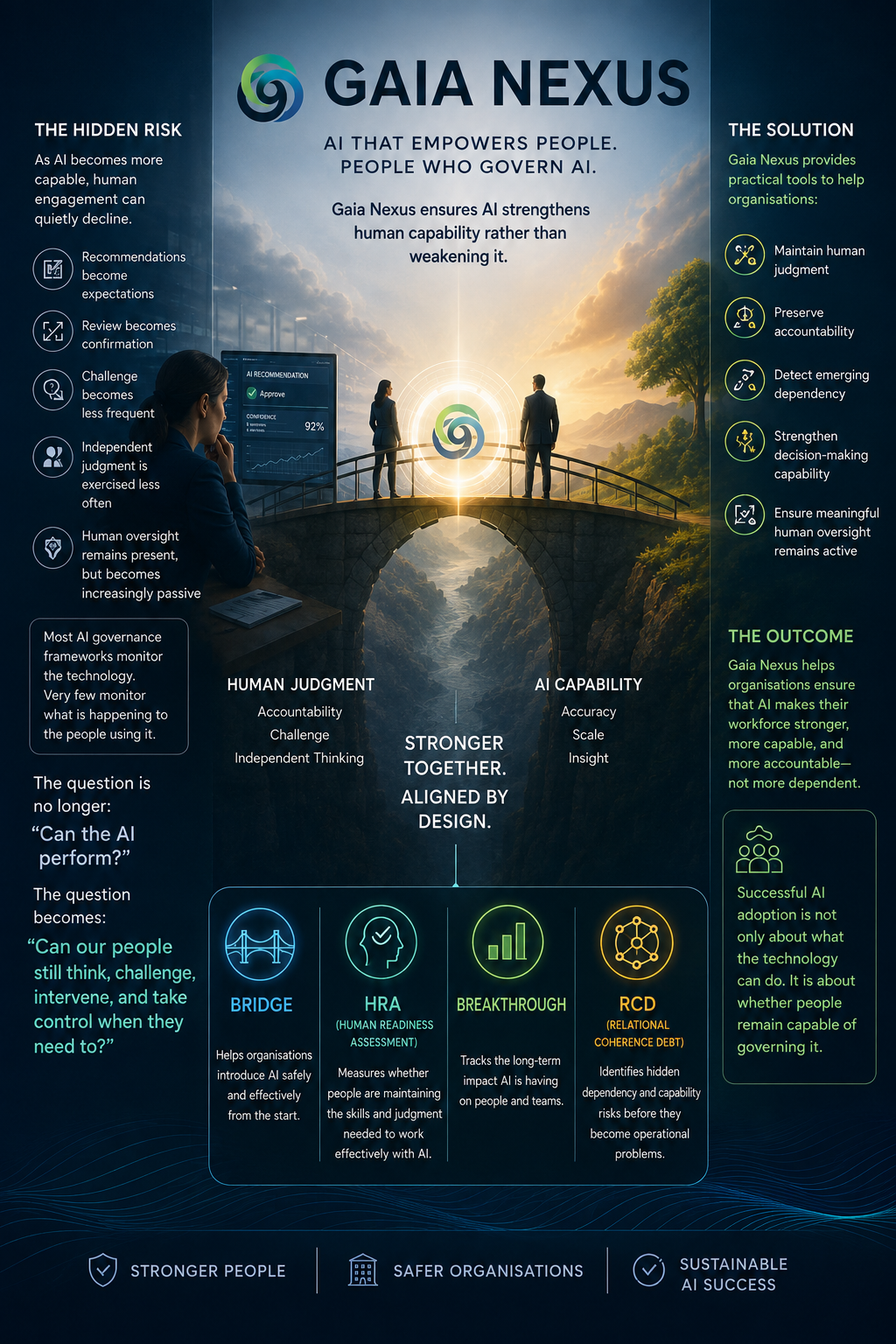
This pattern repeats across departments. Recommendations become expectations. Review turns into quick confirmation. Independent thinking happens less often. Human oversight remains on paper, but in practice it becomes a passive, over simplified routine.
The dangerous part? The organisation still looks successful. KPIs improve. Costs go down. Leaders get promoted. No one notices that the deep human capability needed to govern the AI is quietly eroding.
This is what we call the hidden governance risk. Most AI governance frameworks focus entirely on the technology model accuracy, data privacy, bias detection, audit trails. Very few examine what is happening to the people using the systems, or offer a simplified way to monitor human dependency.
Yet when something unexpected occurs (a market shift, a new regulation, an AI hallucination, or a black swan event), the company suddenly needs humans who can think critically, challenge the system, and take decisive action. If those skills have faded, the organisation is more vulnerable than it realises.
Real World Signs This Is Happening in Your Business
You don’t need advanced metrics to spot early warning signs. Look for these simplified behavioral patterns across your teams:
Teams treat AI outputs as the default answer rather than a starting point for discussion.
Managers can explain what the AI recommended but struggle to explain why it reached that conclusion, failing to give even a simplified breakdown of the logic.
When AI suggestions are wrong, people hesitate or lack confidence to override them.
New employees learn more about using the AI tool than about the underlying business logic and judgment.
Meetings about important decisions become shorter because the AI already analyzed it.
Experienced staff report feeling less challenged or less valuable in their roles.
These changes feel efficient in the short term. In the long term, they create dependency. The business becomes excellent at running the AI, but weaker at running the business when the AI needs human guidance.
Why Traditional AI Governance Falls Short
Standard AI governance is important. It checks if the technology works reliably. But it misses the human side completely.
Think of it like this: You have a powerful new autopilot system for your company’s plane. You monitor the autopilot constantly (fuel, altitude, route). But you never check whether the pilots are staying alert, practising manual flying, or maintaining their skills through simplified readiness exercises.
If the autopilot ever fails, those pilots need to take over immediately. If they’ve been passive for months or years, the results could be disastrous.
This is exactly the situation many businesses face today with AI. They monitor the technology but not the gradual changes in human capability and accountability.
The Gaia Nexus Solution: AI That Strengthens Humans
Gaia Nexus takes a different approach. We help organisations introduce and manage AI in ways that actively build human capability rather than erode it. Our framework ensures people remain engaged, accountable, and ready to lead.
We provide four practical, business-friendly tools designed specifically for this challenge:
1. BRIDGE Safe and Effective AI Introduction
BRIDGE helps companies bring AI into their operations thoughtfully from day one. Instead of a big bang rollout that overwhelms teams, BRIDGE guides a structured, simplified adoption process.
It includes clear protocols for:
Deciding which decisions should involve AI and which should remain primarily human.
Training people not just on how to use the tools, but on when and why to question them.
Building habits of active oversight rather than passive approval.
Teams using BRIDGE report higher confidence and better outcomes because AI is introduced as a partner, not a replacement for thinking.
2. HRA (Human Readiness Assessment)
This is like a regular health check for your team’s decision making fitness.
The Human Readiness Assessment measures whether people are maintaining the skills and judgment needed to work effectively alongside AI. It looks at:
How actively people challenge AI recommendations.
Their ability to explain business context that the AI might miss.
Confidence levels in overriding AI when necessary.
Overall engagement in the decision process.
Results are presented in simplified, actionable reports that leaders can understand without needing a data science degree. It highlights strengths and flags areas where human capability might be slipping before it becomes a serious problem.
3. BREAKTHROUGH Tracking Long Term Impact
AI adoption is a marathon, not a sprint. BREAKTHROUGH tracks the effects of AI on people and teams over months and years.
It monitors trends in:
Decision quality and human involvement.
Team morale and sense of ownership.
Skill development versus skill atrophy.
Overall organizational resilience.
This long-term view helps leaders see patterns that quarterly reports miss. It turns vague concerns about AI dependency into simplified, concrete data and improvement plans.
4. RCD (Relational Coherence Debt)
This is one of our most powerful concepts. Relational Coherence Debt measures hidden dependency and capability risks before they cause operational problems.
Just as technical debt builds up when you take shortcuts in software, RCD builds when humans become overly reliant on AI without maintaining their own judgment and understanding.
The tool identifies:
Areas where people understand less and less about the decisions they’re responsible for.
Growing gaps between AI logic and human intuition.
Emerging risks in accountability chains.
By spotting this debt early, leaders can take corrective action additional training, process adjustments, or changes in how AI is used before it becomes expensive or risky, providing a simplified window into organizational health.
How Gaia Nexus Works in Practice
Implementing Gaia Nexus is straightforward and designed for busy executives.
Assessment Phase: We start with a simplified Human Readiness Assessment and RCD scan to understand your current situation.
BRIDGE Implementation: Roll out AI initiatives with built-in human engagement practices.
Ongoing Monitoring: Use BREAKTHROUGH to track progress and adjust as needed.
Continuous Improvement: Regular check-ins ensure human capability keeps pace with technological capability.
The entire approach uses plain language, simplified dashboards, and actionable recommendations. You won’t need a team of AI ethicists to make it work just committed leaders who care about sustainable success.
The Benefits: Stronger Teams and Better AI Results
Organizations working with Gaia Nexus see multiple advantages:
Better Decisions: AI provides speed and analysis. Humans provide wisdom, context, and accountability. Together they make superior choices.
Reduced Risk: Early detection of dependency prevents nasty surprises when markets change or AI makes mistakes.
Higher Engagement: People feel more valued and challenged when their judgment matters. This improves retention and building a simplified environment for innovation.
Stronger Culture: Accountability remains clear. No one can hide behind the AI said so.
Sustainable Competitive Advantage: While competitors race ahead with technology and risk weakening their human core, your organisation builds both technological power and human strength.
Real Stories from Organizations Like Yours
One mid-sized financial services firm noticed their loan approval teams were approving AI recommendations 95% of the time with minimal review. Using Gaia Nexus tools, they discovered growing gaps in staff understanding of credit risk principles.
Through targeted BRIDGE practices and HRA insights, they adjusted training and decision workflows. Within six months, override rates increased appropriately, decision quality improved, and staff reported feeling more confident and engaged. Importantly, AI continued to deliver efficiency gains without the hidden downside of an over simplified approval pipeline.
Another manufacturing company used RCD tracking to spot increasing reliance on AI for supply chain decisions. BREAKTHROUGH data showed declining team problem solving skills during disruptions. Simple interventions regular scenario planning exercises and simplified explain your override requirements strengthened both human capability and overall resilience.
Why This Matters Now
AI is advancing rapidly. The tools will keep getting better at handling complex tasks. The question every business leader must answer is this:
When the AI cannot handle a situation, will your people be ready and able to step in effectively?
The organizations that thrive in the AI era won’t be the ones with the most advanced technology. They will be the ones whose people remain capable, thoughtful, and accountable through clear, simplified governance standards.
Getting Started with Gaia Nexus
Successful AI adoption is not only about what the technology can do. It is about whether your people remain capable of governing it and whether the technology makes them stronger rather than weaker.
Gaia Nexus provides the missing piece that most AI initiatives overlook: protecting and enhancing human judgment, accountability, and capability through a simplified framework.
If you’re implementing AI in your organization and want to ensure it builds long term strength rather than hidden dependency, we’d love to help.
Visit Gaia Nexus Online or contact us to learn more about BRIDGE, HRA, BREAKTHROUGH, and RCD. The future of work belongs to organizations that keep humans at the center of their simplified AI strategy.