
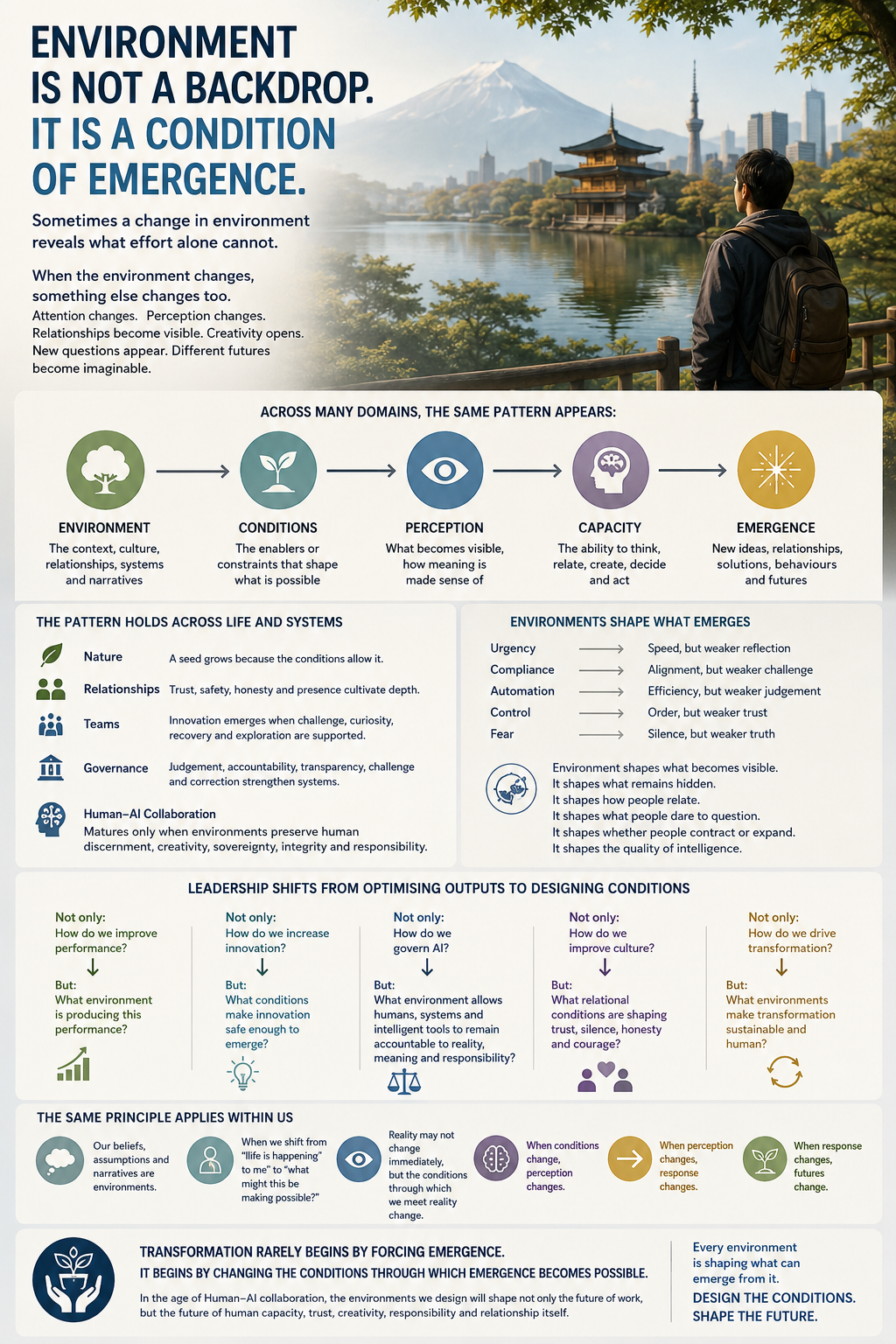
An environment is a concept we constantly try to optimize or ignore entirely. The term often evokes negative thoughts in the modern corporate landscape, treating physical space as a static backdrop. We evaluate a workplace environment through rigid historical testing, viewing this setting as a fixed floor plan. This limited view restricts our progress, because a healthy environment is a dynamic, living system. Today, every organizational environment is being judged by the exact same narrow standard, limiting its deep developmental power. We rank each system environment using basic tests, grading the design of new workflows on simple containment tasks. We check if an executive environment can handle daily stress, or if a digital environment can protect personal time.
We must study how a supportive environment builds upon itself, ensuring that human guidelines stay sharp alongside professional goals. This philosophy of system design changes how we view education, training, and workflow design. When a clear environment is nurtured correctly, those parameters unlock unprecedented creative problem solving. Understanding this environment as an architectural growth process is the ultimate challenge of our time. Without this perspective, our collective progress will plateau. We need a framework that welcomes continuous learning, turning a raw environment into sustainable wisdom.
Most people think progress is solely about raw effort. We assume the only way to achieve more is to push harder, to work longer, and to force things to happen. Perhaps that is exactly why quiet pauses are so frequently resisted in our personal lives, our relationships, and our workplaces. No one wants to feel like they are slowing down.
But what if we have completely misunderstood how growth works? What if pushing harder is not the answer? What if the key is changing the spaces we inhabit?
When you strip away the misconceptions, a change in surroundings does something remarkably important. It shifts our entire perspective. Without these shifts, we stay trapped in the exact same routines, the exact same expectations, and the exact same pressures. The familiar boundaries of our day to day routines begin to shape what we believe is possible.
But when the setting changes, everything else changes along with it.
Every single meaningful relationship in our lives depends entirely upon the space we create for it. There is a common romantic myth that healthy relationships are formed by two people completely losing themselves in one another, merging into a single entity. In reality, the exact opposite is true.
The strongest, most resilient relationships are formed by two distinct people who know exactly where they begin, where they end, and how they choose to meet in the middle. They understand their own values, their own emotional limits, and their own personal space.
When safety and presence are absent or ignored, trust gradually dissolves over time. Responsibility within the relationship becomes incredibly unclear, leaving both people guessing about expectations. Before long, resentment grows silently in the background, and unnecessary conflict becomes far more likely to disrupt the peace.
By knowing how to cultivate a safe shared space, both individuals feel secure enough to open up, share honestly, and connect deeply without the constant fear of being overwhelmed or taken for granted.
This exact same pattern appears everywhere you look throughout the natural world. A living cell survives and thrives specifically because of its membrane. The membrane does not imprison the cell or hold it back from living. Instead, it allows life to exist in the first place. This thin protective layer actively regulates what enters the cell, what leaves it, and what truly belongs inside. Without that crucial cell wall, there is no living system at all, just a disorganized soup of chemicals vulnerable to the elements.
Our favorite games and sports work in the exact same manner. A game of football is only possible because there are sidelines, goals, specific rules, and clear boundaries. If you remove the field markings from the sport, you do not create a state of greater freedom for the players. You simply remove the game itself.
Without the lines, the goals lose their meaning, the scoring system breaks down, and the entire activity quickly degenerates into absolute chaos where no one can display their true skill or strategy.
In the business world, organizations depend heavily upon structured conditions to get things done effectively. We see this manifest as:
Clear lines of authority that show who guides the team.
Individual accountability so everyone knows their specific role.
Well defined decision rights that prevent turf wars.
Structured escalation pathways for solving complex problems.
These elements are not just annoying bureaucracy created for its own sake. They serve a vital purpose. They define exactly who decides, who acts, and who is ultimately responsible for the outcome.
Without these structural setups, daily coordination gradually gives way to widespread confusion. Employees waste valuable time guessing who has the power to sign off on a project, arguments break out over overlapping responsibilities, and overall productivity stalls. Clear definitions give teams the confidence to move fast because they know exactly where their playground ends and where the next team’s begins.
The rapid rise of advanced artificial intelligence is now forcing us to rethink operational design once again. As these digital tools become a regular part of our daily workflows, leaders are rushing to establish new frameworks to keep them safe and effective. We are currently trying to define several critical areas:
Execution limits: Establishing exactly what tasks the software is allowed to perform autonomously.
Authority thresholds: Setting the limits on what kinds of business decisions the tool can make without a manager.
Evidence standards: Demanding clear proof and verifiable sources for the information the system generates.
Permission controls: Restricting access to sensitive data to protect privacy and security.
Human oversight: Ensuring a real person is always in the loop to provide empathy, ethics, and ultimate judgment.
In many corporate circles, these guardrails are often described merely as cold governance controls or restrictive compliance measures. Perhaps they are actually something much more profound. Perhaps they are the essential developmental structures that allow modern intelligence to become truly trustworthy.
A system that operates without any boundaries may become increasingly capable and fast over time, but it will also become increasingly difficult to govern, increasingly difficult to trust, and increasingly difficult for everyday people to understand. By setting clear parameters, we make technology a reliable partner rather than an unpredictable risk.
The exact same principle applies to human development. Think about how we grow from childhood into adulthood, and how we advance from novices into masters of our craft.
Children develop security and confidence through consistent family guidelines. When a child knows exactly what behaviors are safe and acceptable, they feel free to explore their world without anxiety.
Professionals develop their skills through rigorous industry standards. A young engineer or accountant becomes great by learning to operate within the strict limits of their profession’s best practices.
Scientists develop breakthrough insights through highly disciplined, structured research methods. They do not just guess; they follow a rigid process that protects the integrity of their data.
Musicians develop beautiful artistry through hours of repetitive practice within the strict structures of rhythm, scales, and musical theory.
True growth never occurs in the absolute absence of structure. It occurs through meaningful, ongoing interaction with clear limitations. Standards provide the healthy resistance that forces us to sharpen our skills, think deeper, and find creative solutions within our given constraints.
Perhaps this is the grand truth that we have collectively overlooked for so long. Protective settings are not primarily mechanisms of restriction designed to make our lives smaller. They are mechanisms of development designed to help us grow safely and sustainably.
[ Old View of Space ]  ───► A wall that traps you and stops your progress.
                                     vs.
[ New View of Space ]  ───► A foundation that protects you and supports your growth.
They create the healthy tension through which our raw capability matures into genuine expertise. They provide the stable structure through which personal responsibility naturally emerges. They establish the safe conditions through which deep human trust becomes possible, and they offer the protective architecture through which our most cherished relationships can flourish for a lifetime.
Therefore, the most important question for our generation is no longer: How do we remove all constraints from our lives, our businesses, and our technology?
Perhaps the far better question for us to ask is: Which specific systems create the perfect conditions for people, organizations, and intelligent tools to become more capable together?
The future will not belong to those who build systems, lives, or companies with the fewest possible restrictions. It will completely belong to those who deeply understand which setups make sustainable growth, mutual trust, sound judgment, and faithful stewardship possible in the first place. A dividing line is never simply a limit that stops your progress. It is the very condition that allows your identity, your relationships, your responsibility, and your ultimate development to emerge beautifully into the world.