Every organizational framework is a concept we constantly try to optimize or ignore entirely. The term often evokes negative thoughts in the modern corporate landscape, treating physical space as a static backdrop. We evaluate every single workplace through rigid historical testing, viewing this setting as a fixed floor plan. This limited view restricts our progress, because every healthy environment is a dynamic, living system. Today, every corporate branch is being judged by the exact same narrow standard, limiting its deep developmental power. We rank every system using basic tests, grading the design of new workflows on simple containment tasks. We check if every executive can handle daily stress, or if a digital setup can protect personal time.
When every clear parameter is nurtured correctly, those parameters unlock unprecedented creative problem solving. Understanding every single dynamic as an architectural growth process is the ultimate challenge of our time. Without this perspective, every collective step forward will plateau. We need a framework that welcomes continuous learning, turning every raw limit into sustainable wisdom.
The Five Stages of Growth
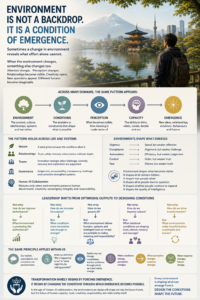
To understand how any workplace transforms, we can look at five simple stages that explain how progress actually happens.
The first stage is the environment itself. This is the overall culture, the physical office space, and the tools we use daily.
The second stage is the conditions. The surrounding environment always dictates these conditions. If your surroundings are chaotic, the conditions will be stressful, which makes focused work nearly impossible.
The third stage is perception. This is how your team members see and interpret their choices.
The fourth stage is capacity. This is the actual ability of your people to solve problems, think deeply, and make smart decisions.
The fifth and final stage is emergence. This is where fresh ideas, organic innovation, and deep trust naturally show up. You cannot force emergence to happen, but you can build the foundation that allows it to flourish.
How an Environment Accumulates Daily Results
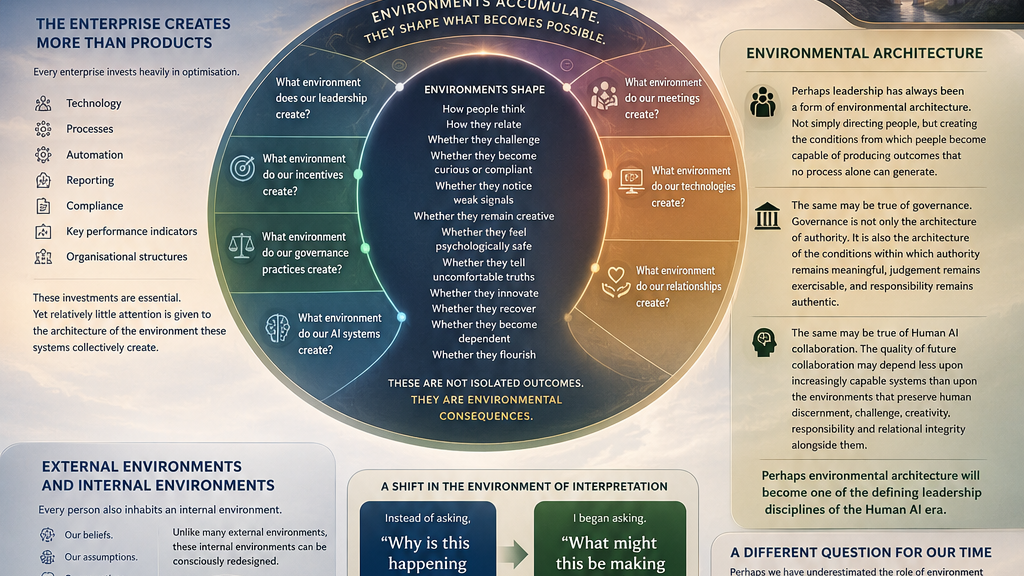
In the business world, we tend to focus entirely on immediate outputs. We check the daily numbers, track project speeds, and review quarterly goals. However, the internal culture and physical environment of an office accumulate silent consequences over time.
For example, a high pressure environment might produce rapid speed, but it completely weakens deep reflection. People become too afraid of making mistakes, so they stop suggesting creative ideas.
On the other hand, an environment built around control might produce temporary order, but it quietly destroys long term trust. When employees feel constantly monitored, they stop sharing uncomfortable truths. They become silent, compliant, and passive. If you want your team to tell the truth and take healthy risks, you have to look at the space they occupy every day.
This is why leadership is shifting from simply directing people to practicing true structural design. Modern leaders are not just managers who assign tasks. They are creators who design the space where work happens.
It is about intentionally designing a supportive system where judgment can be safely exercised. This means creating a culture where curiosity is celebrated, where recovery is valued, and where team members feel safe to voice their disagreements.
This is especially true as we integrate new tools like artificial intelligence. The success of human AI collaboration depends heavily on whether the digital workflow preserves human discernment. If the digital space only rewards speed, we risk losing our critical thinking and human creativity.
Designing Your Internal Space
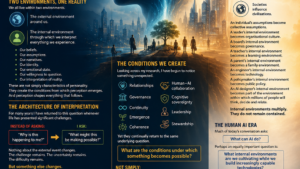
This powerful principle does not only apply to large organizations. Each of us also possesses an internal environment made of beliefs, assumptions, and daily narratives.
You can actively redesign this mental environment to change how you react to difficult situations. For years, many people meet challenges by asking a simple question: Why is this happening to me? This question makes us feel powerless.
When you shift your internal environment from feeling like a victim to looking for new opportunities, your perception changes immediately. By asking, What might this be making possible?, you open up new pathways for action and growth.
Shifting Our Focus for the Future
Ultimately, an environment is never neutral. It is always actively shaping what your team can achieve. If we want better systems, we must start by building a better workplace. The future belongs to those who know how to design a space where human capability can truly flourish.